

Chicken stocking density refers to how many chickens can be kept in a given area in relative comfort and harmony. This section helps you work out what is the minimum and optimal space requirements for your chickens.
The minimum space required to keep chickens in a healthy and happy state varies depending on two things, the size and age of the chickens and the size of the area they are being penned in.
THE SIZE OF THE CHICKENS
Bantam chickens need less space per chicken than large meat chickens.THE AGE OF THE CHICKENS
Chicks and juvenile chickens need less space per chicken than adult ones.
- WHETHER THE CHICKEN NUMBERS REMAIN STATIC OR FLUCTUATE THROUGHOUT THE YEAR
If you let hens raise broods of chicks with the intention of selling or eating the chicks when they reach adulthood your flock may swell to as much as three times the size of the regular flock in the interim before all the chickens raised have been disposed of. The space available should be based on the maximum number of chickens at the height of the breeding season. WHETHER YOU HAVE ROOSTERS AS WELL AS HENS OR ONLY HENS
If you have one rooster than the space requirement is the same as for a hen, but if you have more than one rooster or are raising unsexed chicks with a rooster around then there needs to be enough space for the younger/weaker roosters to be able to withdraw to a safe distance.

Barnevelder hen with chicks. When calculating how much space is needed for your chickens you must consider seasonal chicken number fluctuations.
There are no definitive minimum space requirements for chickens, however there are recommended minimum spaces. Below are the minimum space recommendations per chicken based on the averages from several chicken books and websites. They are for mid-sized chickens.
- COOP SPACE: 1.2 M²
This is the undercover area where the chickens roost at night and the nest boxes are located. OUTDOOR RUN SPACE: 3 M²
The space that the chickens have access to during the day.- PERCH LENGTH: 20 CM
In winter chickens will snuggle up together for warmth but on hot nights they need enough room to perch apart from each other. Lack of perch space also exacerbates disharmony within the chickens’ pecking order. - NUMBER OF HENS PER NEST BOX: 4
While hens tend to lay in a single box if there aren’t enough nest boxes hens may go elsewhere to lay their eggs. There should always be at least two nest boxes even if you have less than eight hens.
Note that these space recommendations are the bare minimum, the larger the area the higher the likelihood that the chickens housed in that area will be happy and healthy. Also note that coop space is not part of the outdoor run space but should be calculated separately. To work out how much space each chicken has in your chicken run combine the coop and chicken run M² areas and divide by the number of chickens. My combined coop and chicken run is 54 M² for five chickens, a total of 10.8 M² per bird. The minimum combined coop and chicken run space is 4.2 M² per bird.

Hyline hens in my main chicken run. Behind them is an enclosed deep litter pen and to the left of the deep litter pen (out of site) is the hen house.

The length of the perch the chickens roost on at night is also important. Chickens tend to huddle together for warmth in winter (as shown in this photo) but on hot summer nights they will often spread out across the perch. It is a good idea to make the length of the perch more than the minimum 20 cm per bird to allow them to do this.
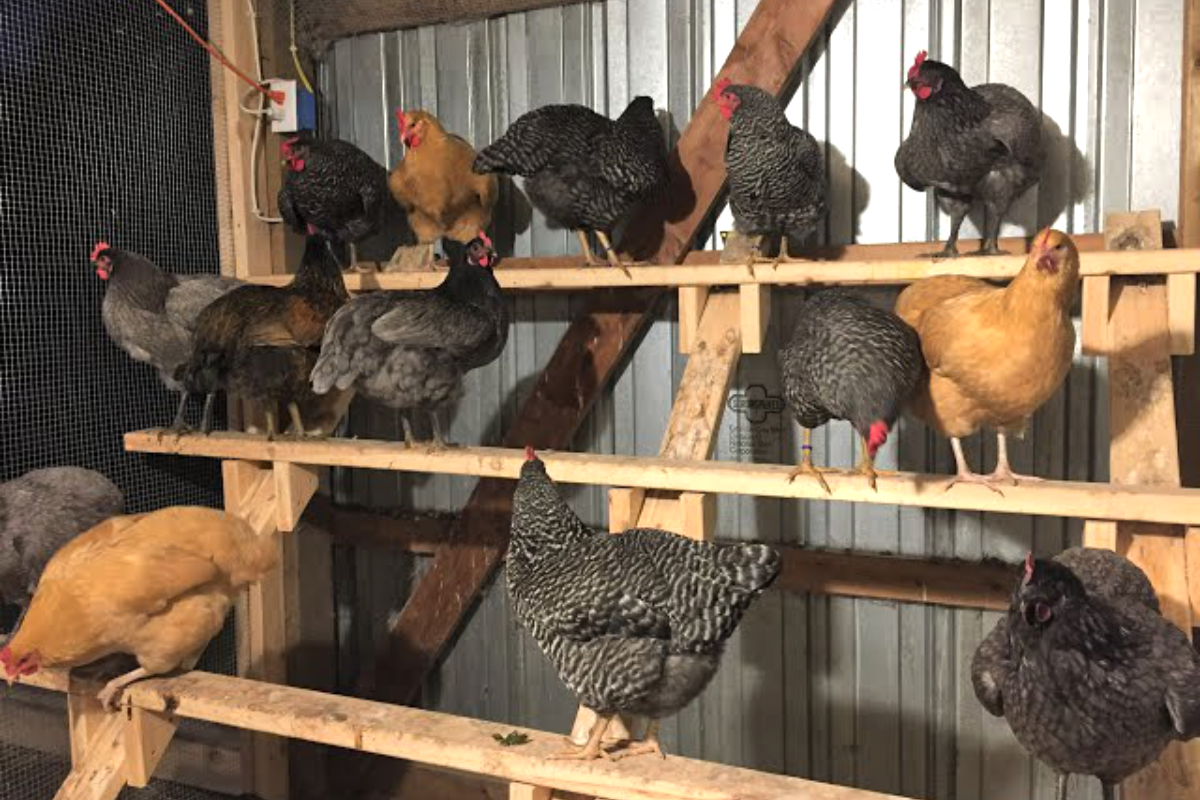
Note that some poultry books and websites recommend perches that are set at different heights, as seen in this photo (image courtesy of the internet), the reason being that this better suits the chickens’ hierarchical social structure (the pecking order) with the dominant birds roosting on the higher perches. I chose to use a bench style roosting platform with all the perches at the same height, that’s because single level perches take up less floor space and it is easier to clean the floor under them than one where the height of the perches vary.

Hen in one of two nest boxes I have for five chickens. I use small rubbish bins on their side as my nest boxes as they can be removed for easy cleaning.


