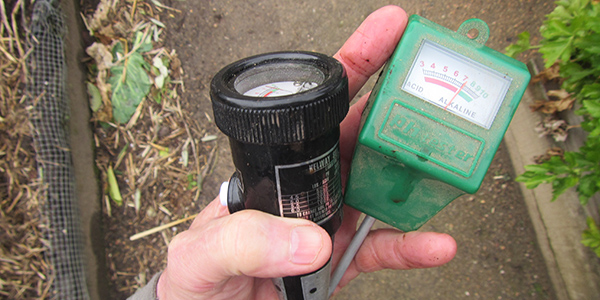
Testing the pH (measurement of acidity or alkalinity) of soil is an important tool in managing a vegetable patch. This page looks at the different ways to measure soil pH.
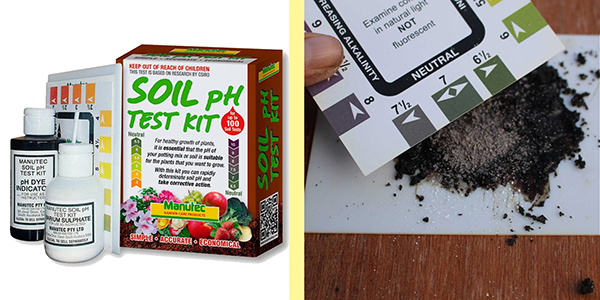
There are several soil pH test kits on the market. They all involve mixing soil with water, adding dye that changes colour according to the pH of the soil, then comparing the colour of the soil with a pH soil colour chart. While I used a soil pH test kit for a number of years I found it to be fiddly and messy. Consequently, I generally did not do as many soil tests as I should have. I no longer use a soil pH test kit, preferring to use a pH meter instead as it is quicker and more convenient.
Manutec test kit, which is the one I used in the past. Images courtesy of the World Wide Web.
There are a number of soil pH meters on the market, ranging from cheap home gardener models all the way through to professional quality meters used by foresters and farmers. They can also be divided into two types of meters, analog and digital. The analog meters do not require a battery while the digital ones do. Note that I have only ever used analog pH meters.
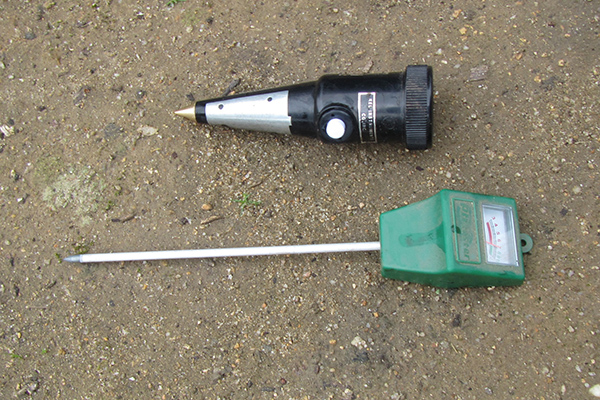
My first soil pH meter was a cheap home garden one. While it was much easier and quicker to use than a soil pH test kit I was concerned that it might not be that accurate. I eventually bought a more expensive professional standard Kelway soil pH meter (see details below). However, while the Kelway is likely to last longer and is easier to read, my comparative soil pH tests showed that the cheap home gardener meter was almost as accurate (see details below) as the more expensive Kelway meter. Though since taking this photo back in 2021 the cheap home garden meter has stopped working.
The test I did to compare the accuracy of my cheap generic pH meter with the much more expensive Kelway professional meter. The difference was very marginal, though the Kelway meter was easier to read.
TOP: Kelway Soil pH & Moisture Meter. This is a professional standard Ph meter used by foresters and farmers. As such it is expensive, costing around $250 AUD (August 2026 prices). BOTTOM: Generic home gardener Ph meter readily available from nurseries and hardware stores from around $15 AUD.
But note that there are many pH meters on the market including ones of a higher quality than the home gardener pH meter shown above but not as expensive as the Kelway meter. However as I have no direct experience with them none are not listed here.
- REMOVE ANY LARGE STICKS OR CLODS OF EARTH FROM THE IMMEDIATE AREA TO BE TESTED
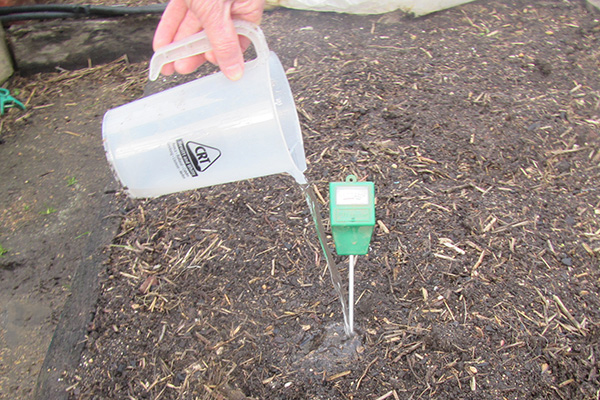
- IF THE SOIL IS DRY THEN POUR SOME WATER ON THE SURFACE AND LET IT SOAK IN FOR A COUPLE OF MINUTES
If wetting the soil it is recommended that distilled water be used as it has a pH of 7.0, which is neutral, though distilled water needs to be stored in an airtight container as when it comes in contact with the atmosphere it absorbs CO₂, which lowers the pH and makes the water mildly acidic. Mains water can also be used if it is fairly neutral, but you need to do a pH test on it as the pH of mains water can vary greatly. - WIPE THE METER’S PROBE WITH A CLEAN RAG
- INSERT THE PROBE INTO THE GROUND AND WAIT UNTIL THE NEEDLE HAS STABILISED BEFORE TAKING A READING
This usually takes about three minutes. The depth that the probe is driven into the soil should be no deeper than the length of a hand trowel. - WIPE THE PROBE CLEAN BEFORE STORING THE METER IN A DRY PLACE
Moistening dry soil. This photo was taken for demonstration purposes only. When testing the soil’s pH the water is poured onto the soil and left to soak in for a couple of minutes before inserting the pH meter probe.