Search

Urban Food Garden

Growing Tomatoes On A Horizontal Trellis

While not as productive as staked tomato plants growing tomatoes on a horizontal trellis involves less work.  It is the ideal way to grow tomato plants for veggie gardeners who struggle to keep up with the regular pruning of laterals that conventional methods of growing tomatoes require.

Growing tomatoes on the ground

Tomatoes can be grown on the ground without any support, especially determinate bush varieties such as KY1 and Roma, however growing tomatoes on the ground presents some issues.  There is a high likelihood of some of the fruit touching the soil, potentially leading to rot and disease problems.  Rats (common eaters of fruit, including tomatoes) are more likely to eat tomatoes on a ground grown tomato plant than ones supported with stakes.  Ground grown tomato plants also have less airflow under them than plants grown on a horizontal trellis or supported with stakes.  Good airflow aids in the ripening of fruit and reduces the likelihood of fungal diseases. 

horizontal tomato trellis - advantages & disadvantages

Growing tomato plants on a horizontal trellis removes a lot of the disease and airflow problems associated with growing them on the ground.  The other big advantage is that it requires less pruning than for staked tomato plants and virtually no tying up of laterals.

The main disadvantage is that only half the number of tomato plants can be grown in a given area compared to staked tomato plants.  And as the plants are lower to the ground than staked tomatoes more bending is required when tending them.  

Reinforced concrete mesh horizontal trellis

Horizontal trellises can be built using a variety of materials.  However, these instructions are based on my horizontal trellis frame, which is made from reinforced concrete mesh with 20 cm square holes.  The advantage of using reinforced concrete mesh is that it is self-supporting, making it quicker and easier to set up and dismantle.

Constructing a reinforced concrete mesh horizontal trellis
  1. CUT A SECTION OF MESH THAT IS NO WIDER THAN THE WIDTH OF A RAISED BED AND HOWEVER LONG IS PRACTICABLE
    This will be the horizontal section.  Mine is 1.2 metres wide by 2.4 metres long.
  2. CUT TWO SECTIONS OF MESH 40 CM WIDE AND THE SAME LENGTH AS THE HORIZONTAL SECTION 
    These will be used to support the horizontal section above the ground.
  3. CUT OFF ONE EDGE OF EACH OF THESE 40 CM WIDE STRIPS OF MESH TO CREATE SINGLE RODS ON ONE SIDE

LEFT: Section of reinforced concrete mesh used to create the vertical support for the horizontal trellis.  It consists of two rows of 20 cm wide square mesh with the bottom edge cut off.  The pins that this cut off edge creates are driven about 10 cm into the ground, which provides enough support to keep the mesh upright.  RIGHT:  Piece of the mesh used as the horizontal section.

  1. PLACE THE TWO THIN SECTIONS ABOUT A METRE APART IN AN UPRIGHT POSITION
    Drive the ends of the rods 10 cm into the ground to support the uprights vertically.
  2. PLACE THE HORIZONTAL SECTION ON TOP OF THE TWO VERTICAL SECTIONS
Growing tomatoes on a horizontal trellis
  1. PLANT A SINGLE ROW OF TOMATO PLANTS IN THE CENTRE OF THE BED
    5 to 6 plants for a 2.4 metre long trellis.  When I first used the horizontal trellis method I planted two rows of tomato plants but found that this created overcrowding problems.
 
  1. CUT ALL LATERALS OFF THE MAIN STEMS UNTIL THE TOPS OF THE PLANTS ARE ABOVE THE LEVEL OF THE MESH
  1. LEAVE THE LATERALS ABOVE THE MESH TO GROW FREELY OVER THE TOP. ONLY PRUNING THEM WHEN THEY BEGIN TO GROW OVER THE EDGE OF THE TRELLIS/b>

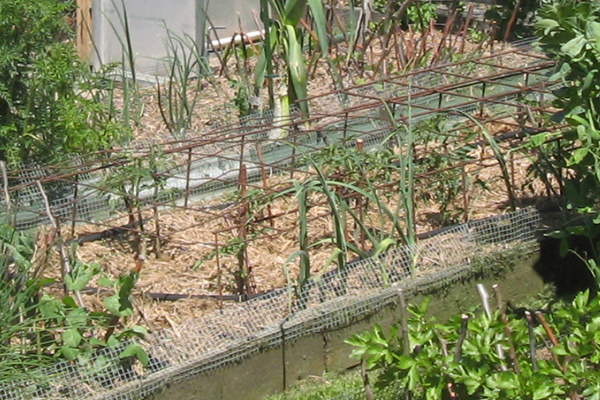
Photo of a horizontal trellis that I used back in 2007.  While this photo shows two rows of tomato plants, I mostly planted only one row as I found that two rows would overcrowd the trellis. 

alternatives to reinforced concrete mesh horizontal trellises

An alternative to reinforced concrete mesh is to use soft wire mesh nailed onto a wooden frame.  Bricks can be used to create the vertical supports, in fact the old gardener I originally got the idea from used bricks.  He would start with one brick in each corner and then, as the tomato plants grew bigger, jack up the frame to a height of three bricks.

Using a horizontal trellis as protection from frosts

Another advantage of a horizontal trellis is that it makes an ideal frame to protect early season tomato plants from late frosts.  This photo was taken in 2020.  While I no longer grow tomato plants using the horizontal trellis method I still occasionally use the frame to protect early season tomato plants.

ADVANTAGES SUMMARY
(flip me)
ADVANTAGES
  • Requires less pruning than for staked tomato plants and virtually no tying up of laterals.
  • Better air flow and disease control than tomato plants grown on the ground.
  • Makes an ideal frame to protect early season tomato plants from late frosts.
DISADVANTAGES SUMMARY
(flip me)
DISADVANTAGES
  • Uses more space per plant than staked tomato plants.
  • Lower to the ground, so more bending required when harvesting tomatoes.

RELATED POSTS