This page is part of the “DEFEND” section of the Three Ds Pest Control program, which is a gradual three stage approach to protect vegetables from pests that is designed to minimise the use of pesticides. DEFEND is when you actively kill pests attacking your plants, but only with environmentally friendly methods and only after DETER methods have failed. For an overview of the Three Ds Pest Control program see PEST CONTROL: The Three Ds.
The simplest method of getting rid of large slugs and snails is to go out into your garden at night with a torch and remove them by hand. Going out for two or three evenings in mid-spring for a half hour hunt can make a large dent in your gastropod population.
They can be killed by: –
- Putting them in salty water.
- Crushing under foot or a brick.
- Feeding them to your chickens.
By hand removing slugs and snails not only can you get rid of large numbers of these pests quickly but you will also be able to work out where the biggest concentrations of them are coming from, so you can target those areas with other pest control methods.
Large slugs and snails can be easily collected at night by torchlight.
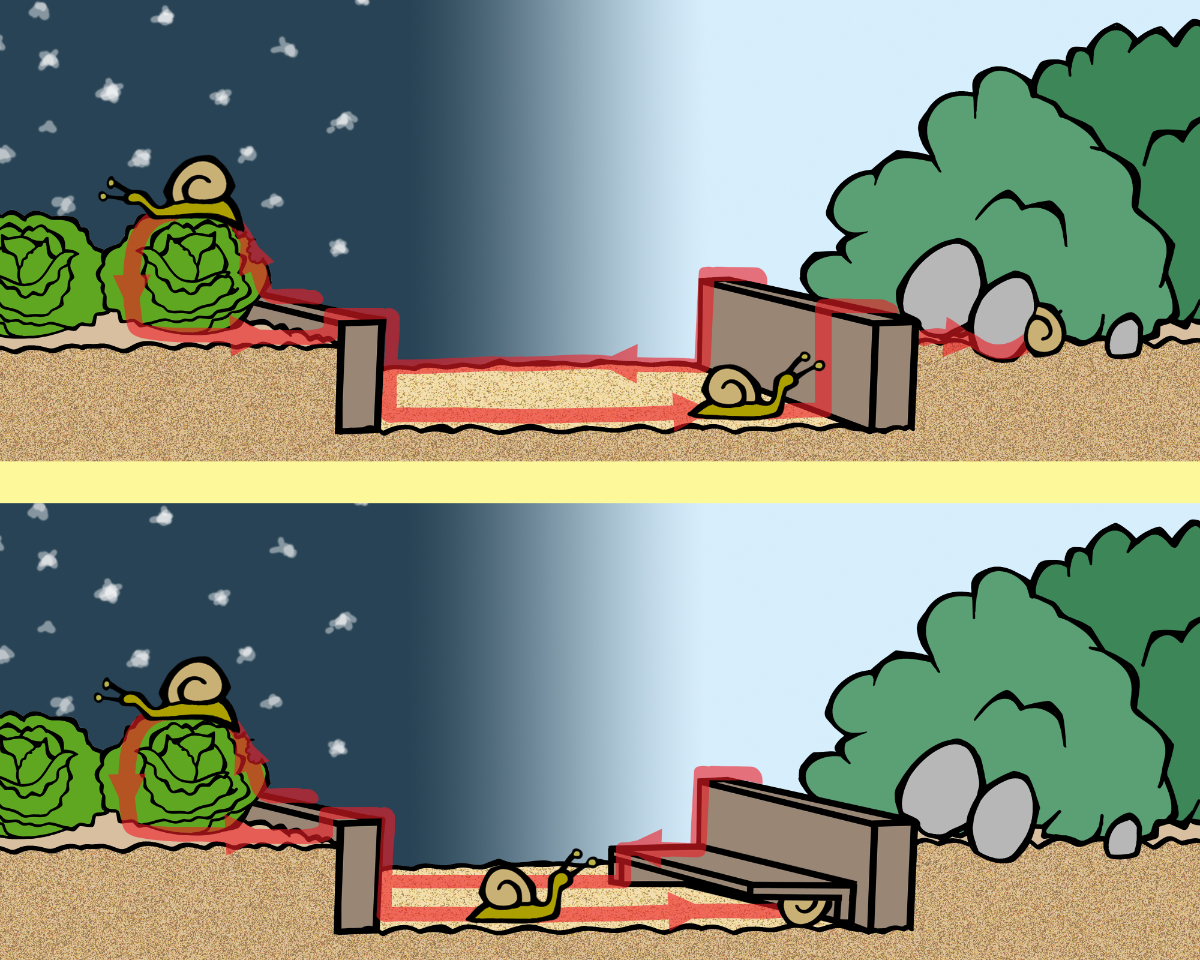
Large slugs and snails often travel into a vegetable patch from nearby cover to feed at night, returning to the cover to hide during the day.
If you place objects, such as pieces of old timber or damp Hessian bags, on the edges of your vegetable patch then a percentage of these travelling slugs and snails will end up under these objects during the day. All you need do is occasionally lift up the timber or Hessian and remove any slugs and snails that are hiding under them.
Old pieces of timber or hessian left at the edges of your vegetable patch act as good cover traps for large slugs and snails.
Cover traps encourage slugs and snails to hide where they can be easily collected and disposed of.
Essentially they are a beer filled container that is used to first lure then kill slugs and snails. The sweet sickly smell of the beer is the attractant and the alcohol in it is the poison. Slugs and snails that drink the beer become extremely sick and end up slipping into the beer and drowning.
While beer traps are effective at killing small slugs they aren’t as effective on larger snails. They are also fairly high maintenance as the beer has to be replaced with fresh beer on a regular basis.
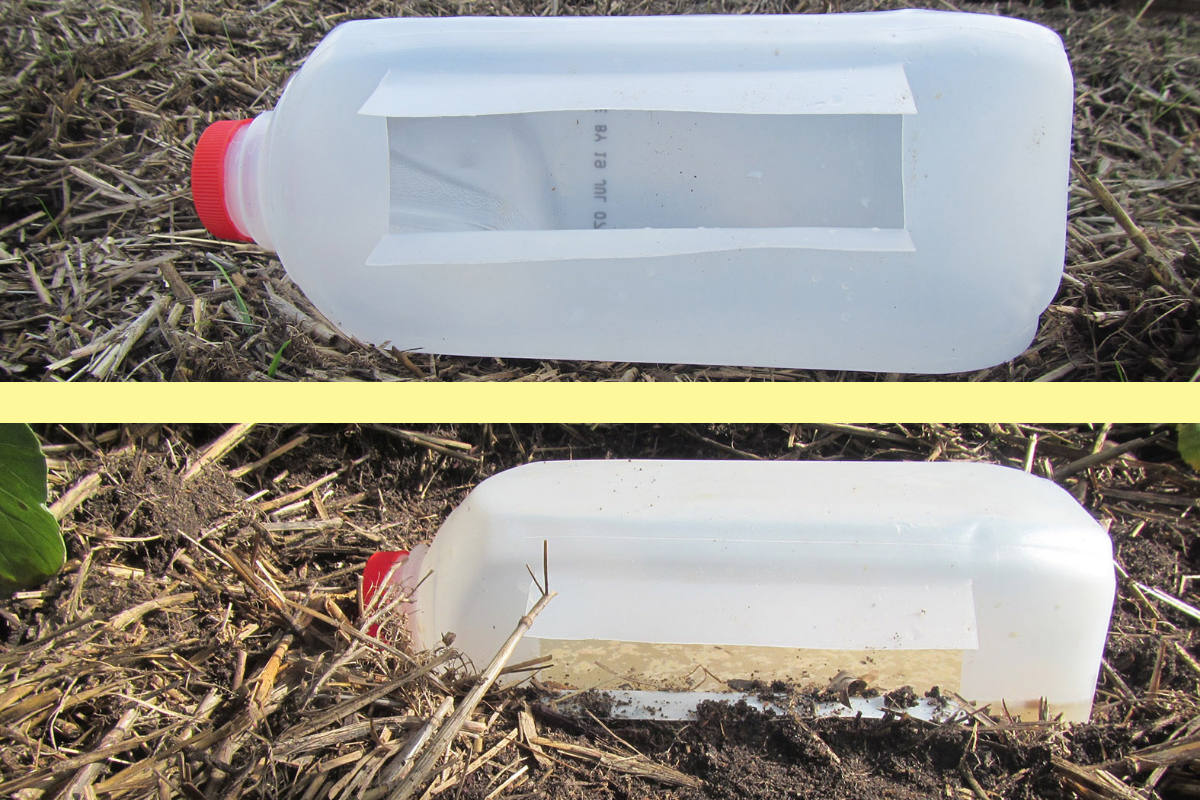
There are commercially available beer traps on the market but you can also make your own traps. There are a number of ways to make a beer trap but my preferred method is to make one out of a 2lt milk carton as it is a large capacity trap that offers good protection against rainwater entering the trap and diluting the beer mixture inside. A diluted beer mixture will be ineffective.
- TAKE AN EMPTY 2 LT PLASTIC MILK CARTOON AND TURN IT ON ITS SIDE
- MAKE A HORIZONTAL CUT OF ABOUT 14 CM
The cut should be closer to the top of the plastic bottle. The best way to make the cut is with a box cutter or Stanley knife. - MAKE A VERTICAL CUT OF ABOUT 5CM AT EACH END OF THE HORIZONTAL CUT
Each vertical cut should be about 2 1/2 cm above and below the horizontal cut.
- BEND THE EDGES OF THE HORIZONTAL CUT OUTWARDS
This will create a bottom and top flap. The bottom flap provides a ramp for the slugs and snails to enter the trap while the top flap acts as an eave to stop rainwater entering the trap. - FILL THE BOTTLE WITH BEER OR A FERMENTED SUGAR SOLUTION
- PUSH THE BOTTLE INTO THE GROUND SO THAT THE BOTTOM FLAP IS AT GROUND LEVEL
TOP: The beer trap after the cuts have been made and the flaps bent outward. BOTTOM: The trap after it has been filled with a fermented sugar solution and pushed into the ground so that the bottom flap is at ground level.
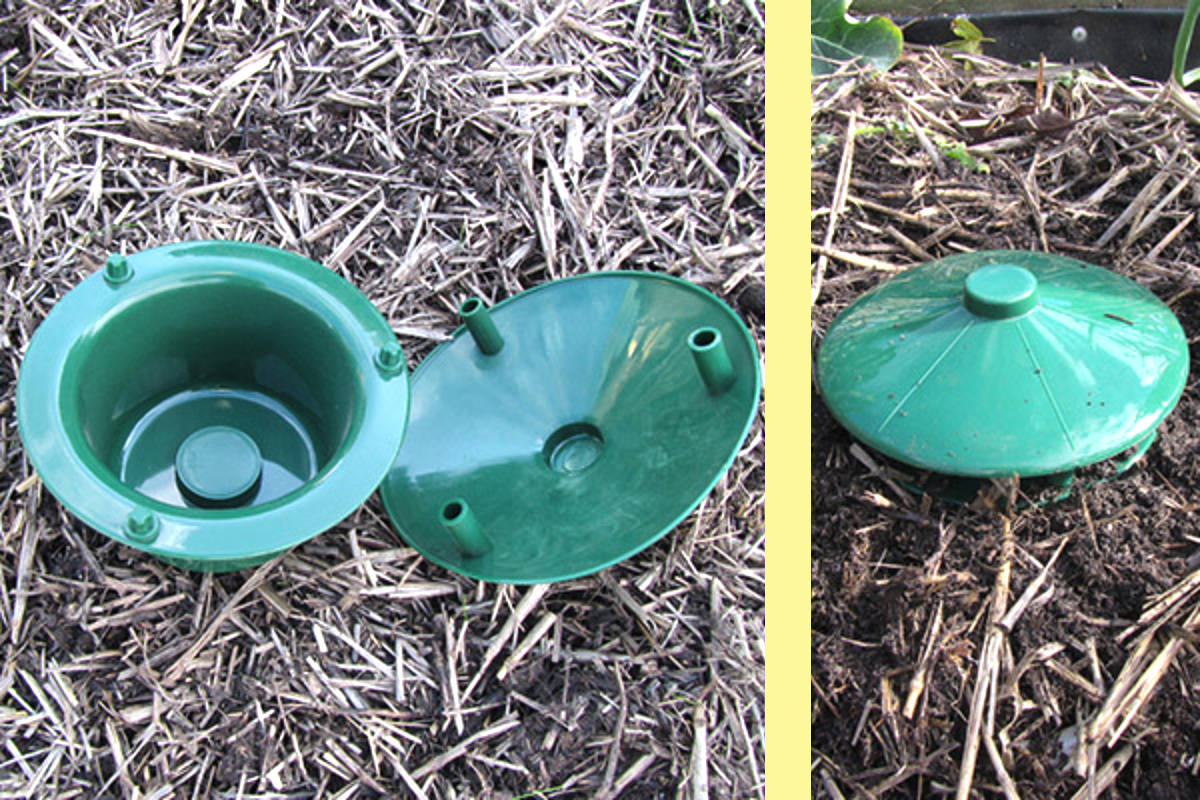
A commercial beer trap that is readily available at nurseries and hardware stores
The problem with beer traps is that, compared to alternatives like snail pellets, beer is expensive. A cheaper alternative is to create your own alcohol with the use of fermented sugar.
To make fermented sugar simply mix a few tablespoons of sugar with some warm water and add a couple of teaspoons of powdered yeast. The fermentation that occurs will create the poisonous alcohol.
While fermented sugar is slower to act than beer it is a lot cheaper and, if the fermentation is strong enough, just as effective.
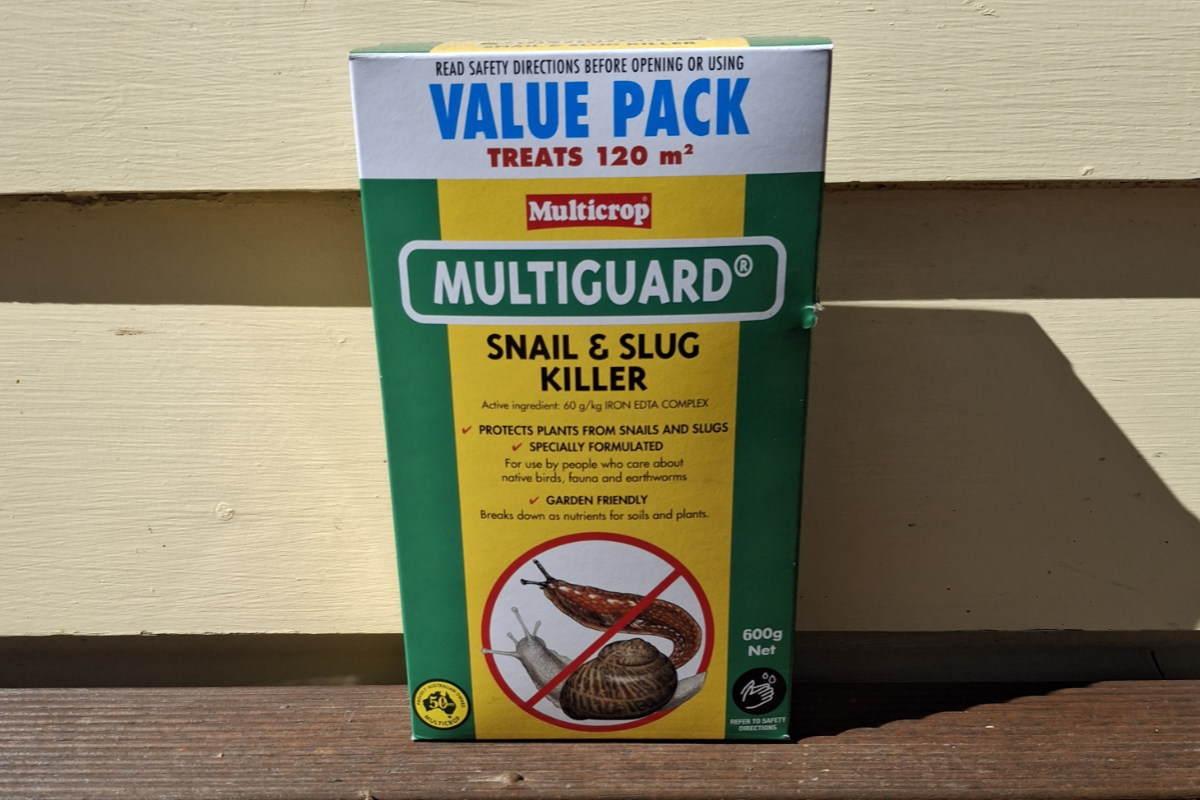
Iron EDTA complex pellets are more environmentally friendly than Metaldehyde pellets as they break down into iron and EDTA (Ethylenediaminetetraacetic acid), which degrade into harmless components in the soil, such as plant nutrients and biodegradable compounds. They are safer for pets, kids, and wildlife when used as directed, as the active ingredient is food-grade, but large ingestion by pets can still cause issues, so caution is advised.
Their down side is that they cost more, break down more quickly and are slower to kill slugs and snails than Metaldehyde pellets. However they still represent a much better alternative to Metaldehyde pellets and are more effective and involve less maintenance than beer traps.
Iron EDTA pellet box. Note that the packaging looks like a standard Metaldehyde pellet box, even though the contents are very different.