
While black scale can infest a range of trees and shrubs citrus trees are particularly prone to being attacked by them. This page explains how I control black scale on my citrus trees.
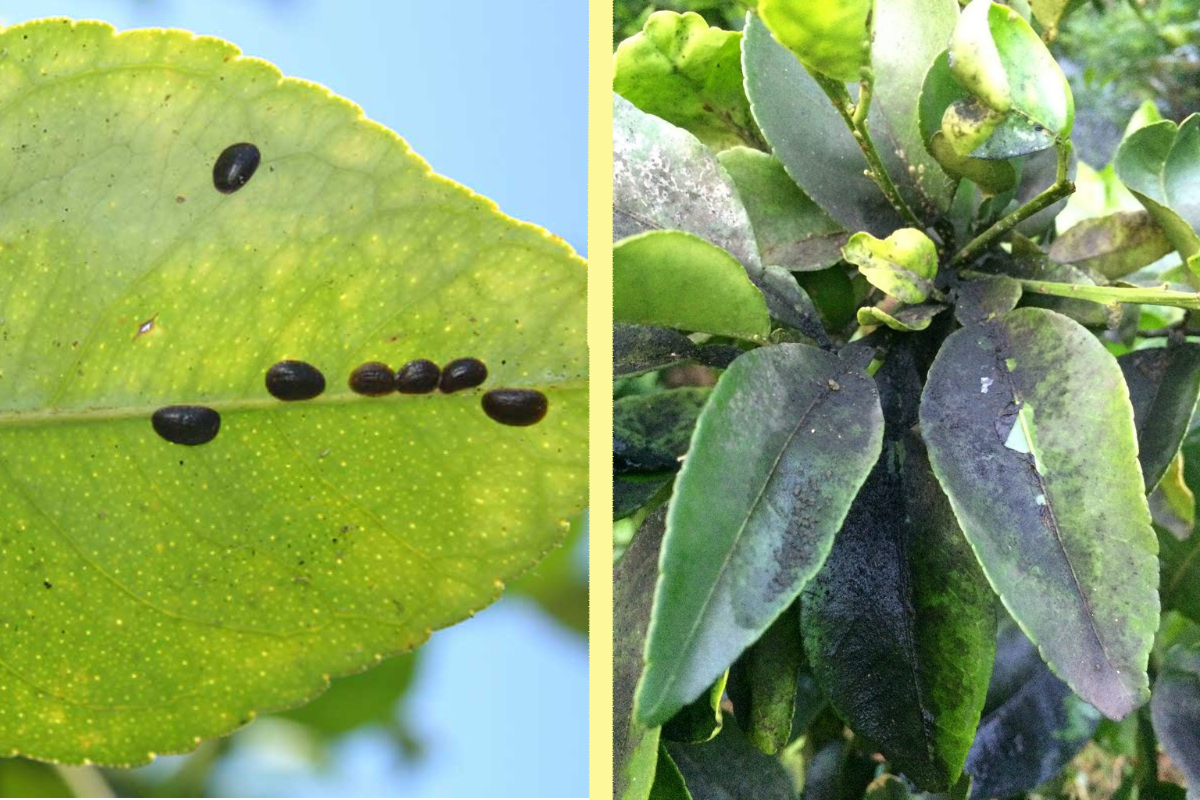
Black scale is an insect that can be identified by its small, dark, convex, and leathery-looking shell. Black scale feeds on sap, they also produce honeydew (a sweet sticky liquid, which is excreted) as a by-product of their feeding. The honeydew spreads to nearby parts of the tree, on which sooty mould establishes, blackening leaves, twigs and fruit. This combination of sap suckering and sooty mould can cause fruit drop, leaf wilting, twig dieback, and even plant death in severe cases.
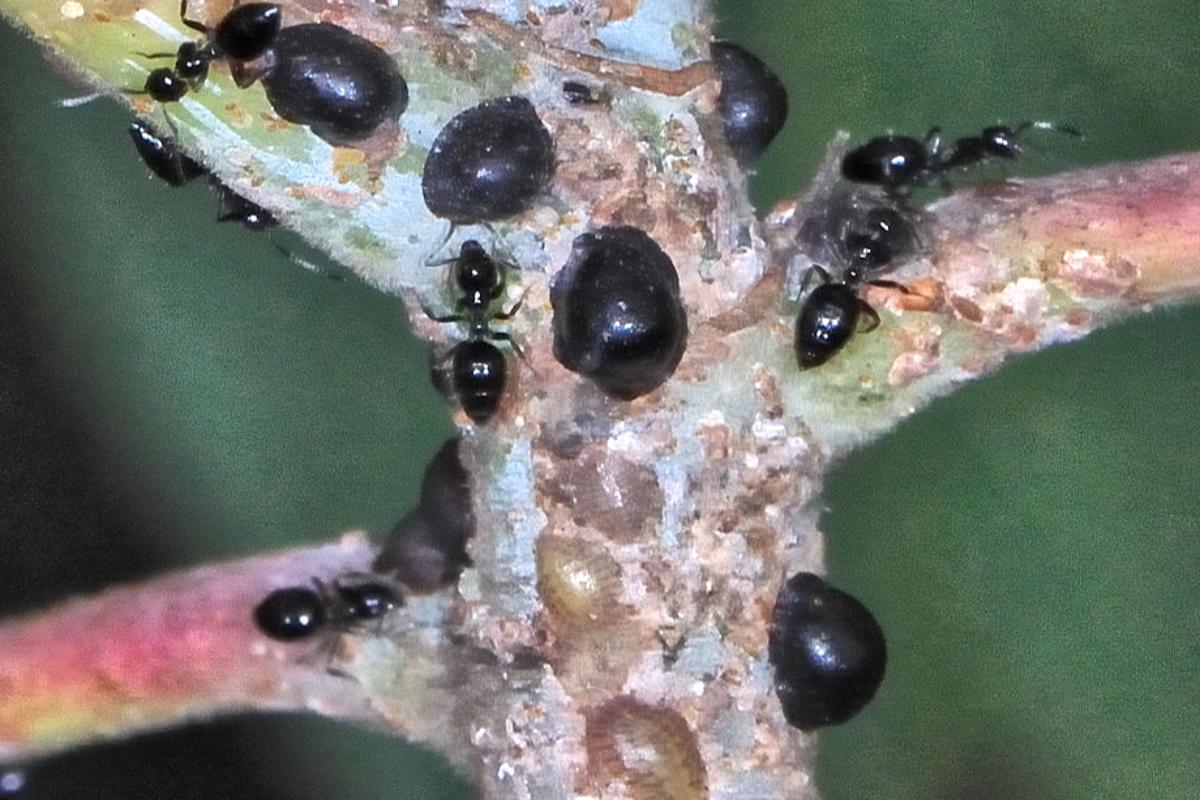
Black scale has a symbiotic relationship with ants. The honeydew the black scale secrete is harvested by ants, who in turn protect the scale from predators and will even move juvenile scale from one tree to another.
LEFT: Black scale on a citrus leaf. RIGHT: Sooty mould on citrus leaves. Sooty mould grows on the honeydew that black scale secrete. Photos courtesy of the internet.
Ants act as farmers for black scale, protecting them from predators and harvesting the honeydew that the scale secrete. Photo courtesy of the internet.
Scale is traditionally controlled by spraying with white oil. It is an organic based mixture that works by smothering the scale. While it is effective for dealing with stationary adult scale it is not so good against mobile juvenile scale who can wriggle to the surface of the oil film. Nor will it kill the ants protecting the scale.
By combining white oil and pyrethrum you get a more effective treatment for scale. The white oil kills the adult scale by smothering them while the pyrethrum poisons the juvenile scale and any ants on the tree at the time of the spraying. I have found it to be more effective at controlling scale than just using white oil.
My healthy tangelo tree. In past years past this tree was infested with black scale and covered with sooty mould, but with regular doses of the White oil and Pyrethrum combination spray I was able to eradicate the black scale.
To prepare a mixture of white oil & pyrethrum fill a container with water then add the recommended dose of white oil concentrate for that amount of water. Then add the recommended dose of pyrethrum concentrate to the same water. Stir thoroughly than spray using a pressure sprayer, making sure to cover the surfaces of all the leaves and stems. Spray again in a couple of weeks after the first spraying to ensure all the scale are dead.
White oil does not directly poison insects but covers them with an oily coating that makes it impossible for them to breathe. It is readily available in a pre-mixed form, but you can also make it yourself.
To make it add a cup of ordinary vegetable oil and 1/4 cup of dishwashing liquid to a container and shake vigorously to combine the two ingredients.
Pyrethrum is made from the pyrethrum daisy, and as such it is considered a natural organic pesticide. However, it is still a broad-spectrum killer, meaning that it will kill all types of insects, including ones beneficial to your garden such as lady beetles and lacewings.
LEFT: white oil concentrate. RIGHT: pyrethrum concentrate.
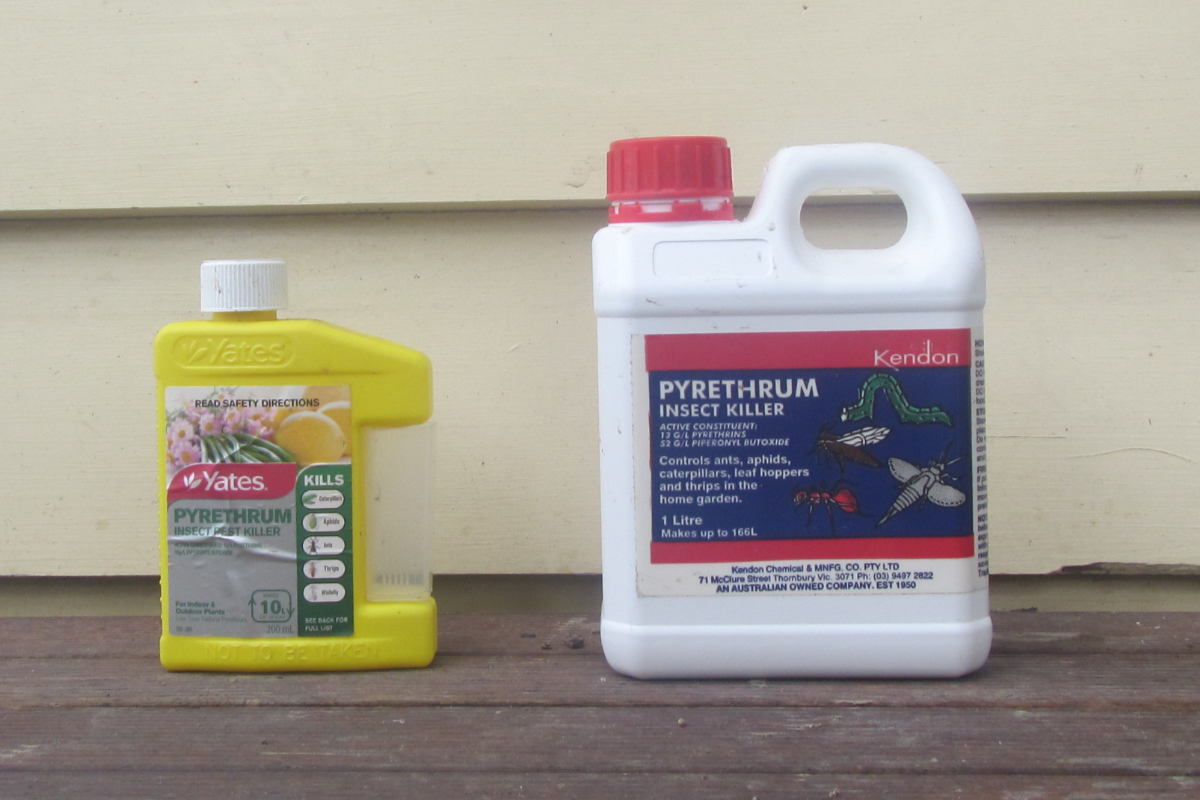
LEFT: Yates 200 ml pyrethrum concentrate. RIGHT: One litre Kendon Pyrethrum concentrate. Buying the concentrate in larger containers (as I do) is more cost effective than buying it in small containers.
While white oil on its own does deal with black scale infestations the white oil and pyrethrum combination treatment is particularly effective as it kills the adult black scale, the mobile juveniles and the ants that protect them in a single action. Yates make a readymade combination of white oil and pyrethrum called Pest Oil Concentrate, but it is cheaper to make up your own mixture. White oil and the white oil and pyrethrum concentration can be also used to treat other types of scale.


