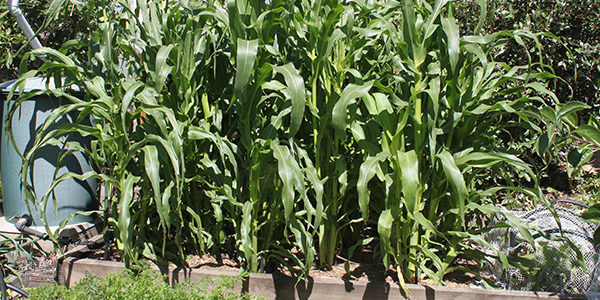
Corn is easy to grow but it has specific requirements that must be met if you want to grow large fertile cobs. This page explains how I grow my corn.
- RICH WELL DRAINED SOIL
- PLENTY OF FERTILISER
They are heavy feeders. - FULL SUNLIGHT
- PROTECTION FROM STRONG WINDS
- REGULAR WATERING
- 12 TO 14 WEEKS TO REACH MATURITY
- FROST FREE ENVIRONMENT
Apply fertilisers as per the Heavy Feeder Vegetables rate then turn the bed over and rake it flat.
Note that this planting guide is for South Eastern Australia only. To view a printable PDF of this corn planting guide click HERE.
- TRADITIONAL SPACING
30cm apart in each row and 75cm between rows. - RAISED BED COMPACT SPACING
35cm apart in a triangulated pattern. For more details see: Planting Corn In A Raised Bed
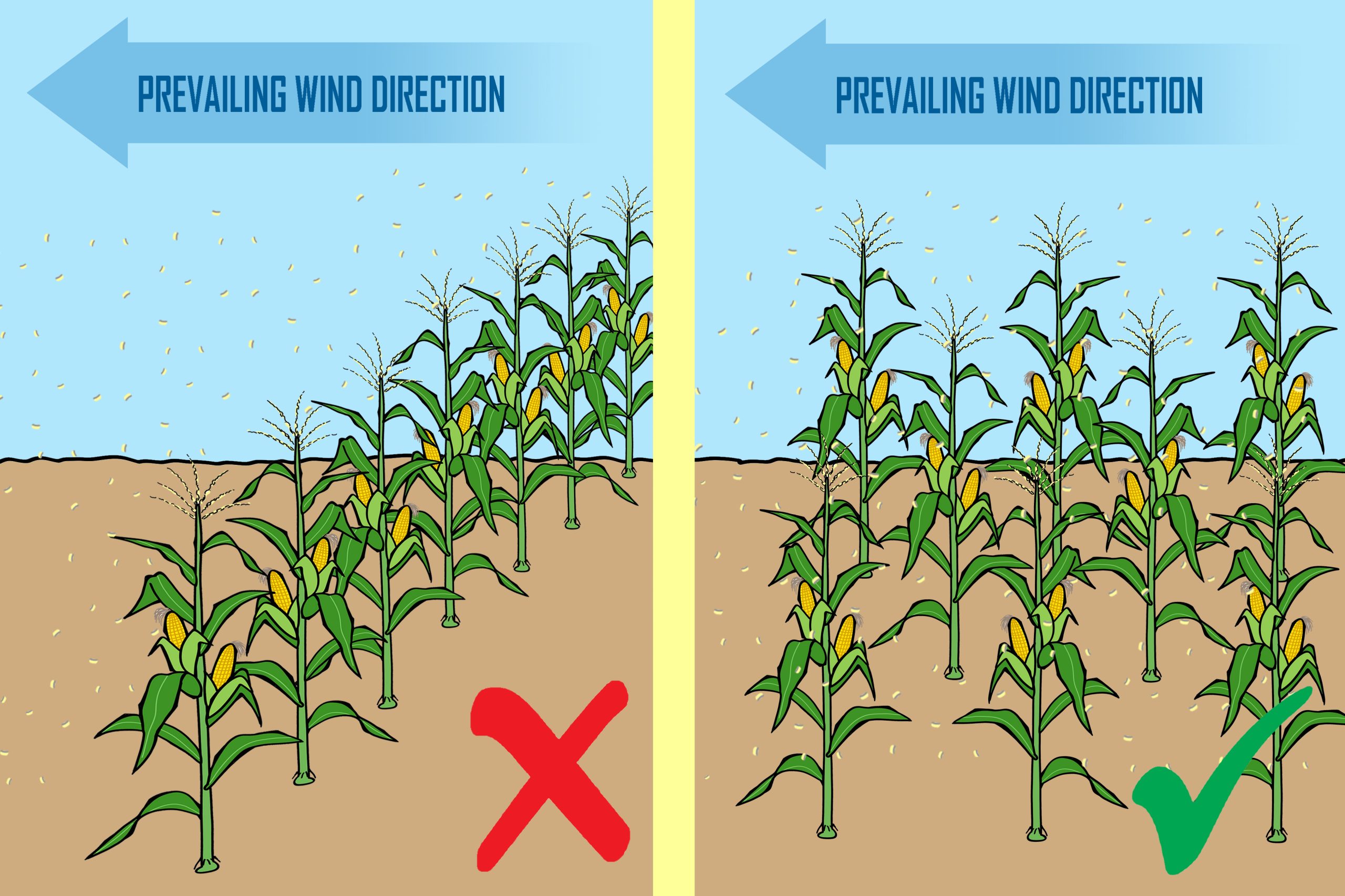
Corn is wind pollinated, in order to maximise pollination it is best to plant it in a block rather than a single row. That way the pollen is more likely to be blown onto neighbouring corn plants. This is especially so if a single row of corn is planted at right angles to the prevailing wind. You will know if your corn cobs have not pollinated properly as some or all of the corn kernels do not swell up
Corn needs to be grown in a block of at least eight plants to maximise pollination rates.
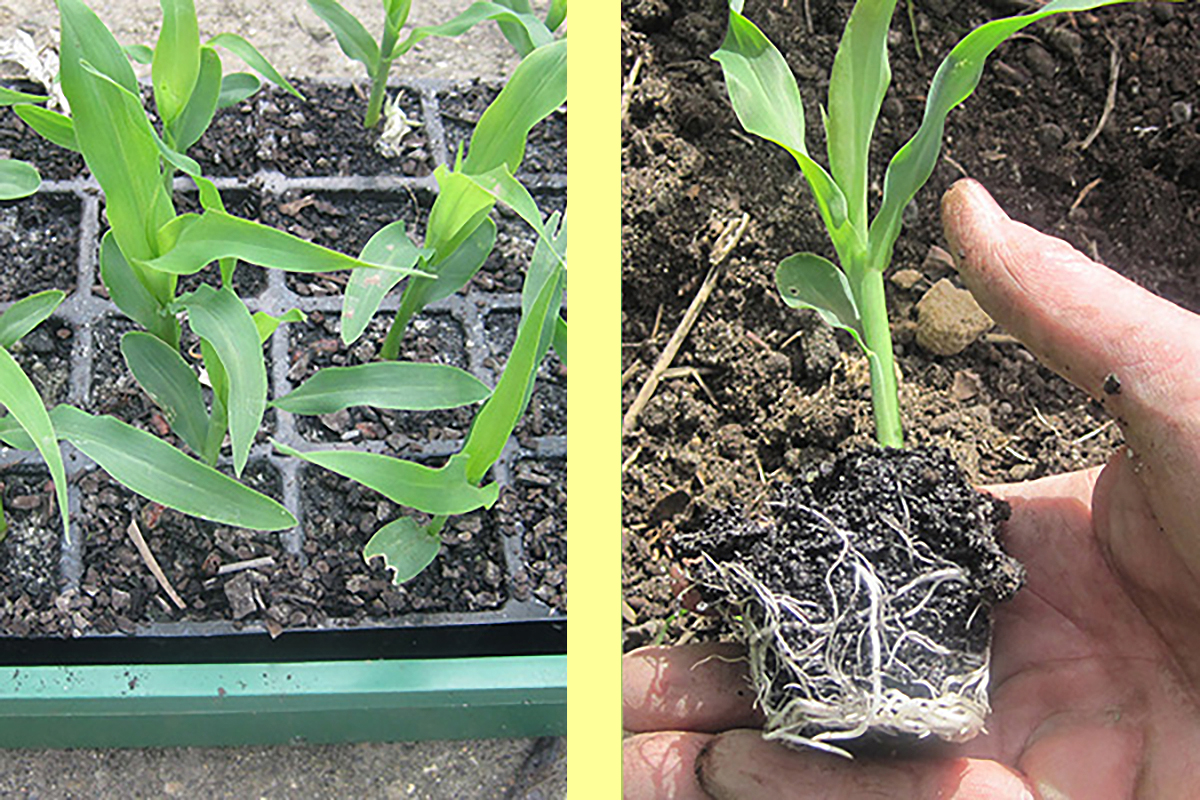
Corn can be planted as seeds or seedlings, though as corn seedlings do not like having their roots disturbed if you are going to plant seedlings then the seedlings should be grown in single cell seedling trays.
PLANT 2 to 3 SEEDS 2 CM DEEP IN A TIGHT GROUPING IN EACH PLACE YOU INTEND TO GROW A CORN PLANT
THIN OUT TO THE STRONGEST SEEDLING IN EACH GROUP WHEN THE SEEDLINGS ARE ABOUT 4 OR 5 CM HIGH
Lay any surplus removed seedlings next to the remaining ones as they will act as decoy food for slugs and snails.IF ALL THE SEEDS FAIL IN A SINGLE GROUP THEN CAREFULLY TRANSPLANT A SPARE SEEDLING FROM A NEIGHBOURING GROUP
Do not replant failed groups with more seeds. This is because all the corn needs to mature at the same time if they are to be properly pollinated.
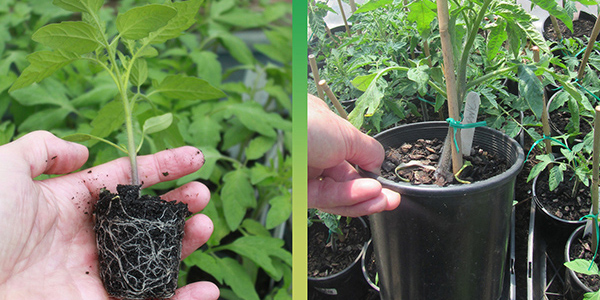
Corn seedlings do not like having their roots disturbed. If you are planting seedlings they will transplant more easily if they have been grown in single cell seedling trays as this minimises root disturbance.
Water both the roots and leaves of the seedlings with liquid fertiliser when transplanted. This is because leaves can also absorb nutrients. Watering seedlings with liquid fertiliser increases the survival rate and helps them to establish more quickly.
Corn seedlings grown in single cell seedling trays will transplant more easily.
Corn’s watering requirement is moderate to high, with its highest water demand being when the cobs are forming. In dry weather it is best to give them a heavy water every second or third day rather than a light watering every day. Place mulch around the base of the corn once the weather warms up to minimise water loss due to evaporation.
These are the pests that present the main threat to corn plants in my garden, though there are other types of threats.
Can scratch out seeds and seedlings in their quest for worms, especially when the rest of the garden is dry. For information on how to protect your young corn from blackbirds see: PEST CONTROL – Birds.
Can do significant damage to seedlings but once the corn has grown to the height of 10 cm the risk of further damage is minimal. For information on how to protect your young corn from slugs and snails see: PEST CONTROL: Slugs & Snails.
Sometimes my maturing corn cobs have been attacked by Corn Earworm caterpillars. But as these caterpillars tend to only damage the tops of cobs and never more than a few cobs in each crop they are not a serious problem. Although you can spray a pesticide to kill them I simply remove them by hand when discovered. If your corn cobs have been attacked by Corn Earworm caterpillars then just cut off the damaged part, the rest of the cob will still be quite edible.
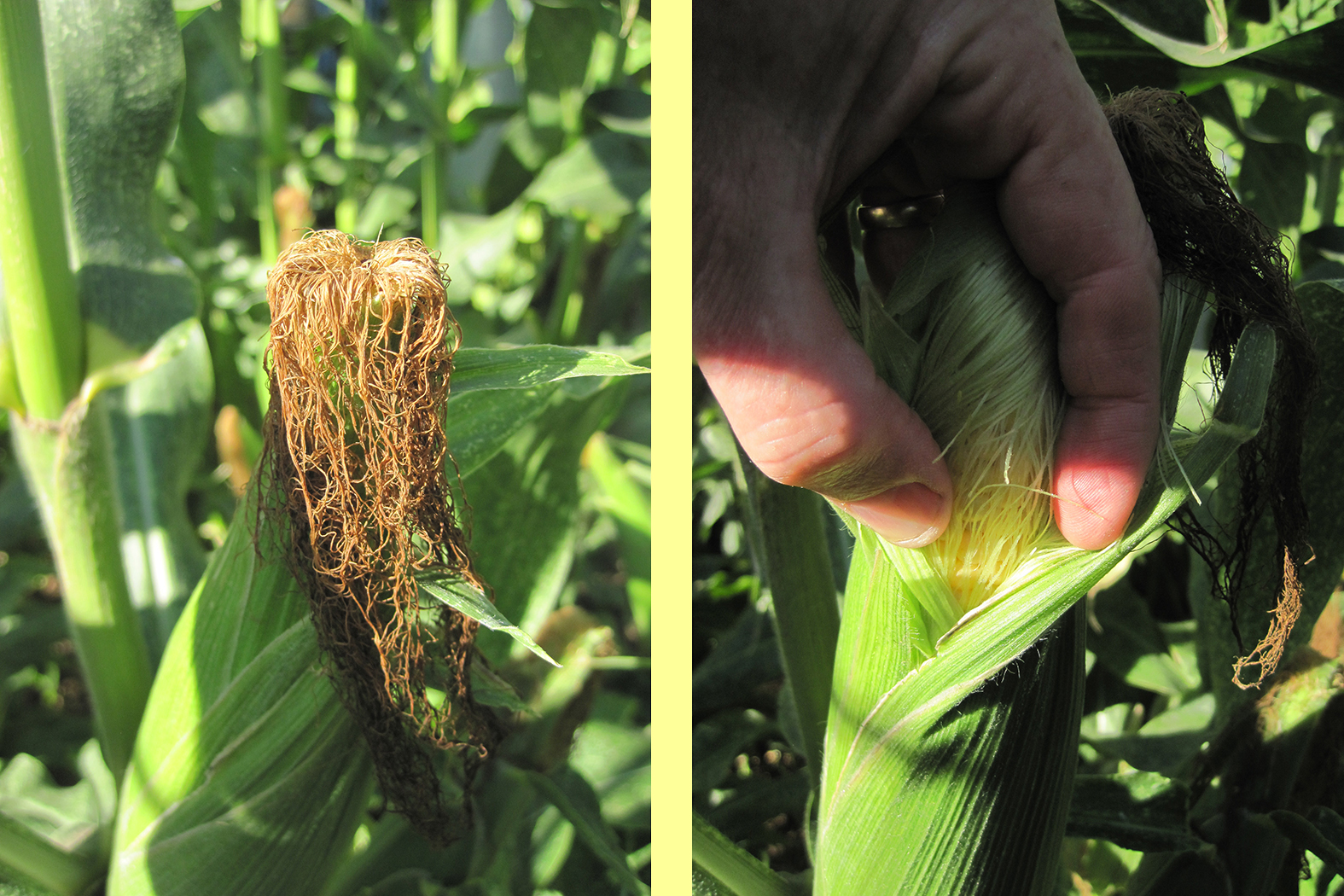
Corn usually takes between ten and twelve weeks to mature. The cobs are generally ready to be picked when the tassels turn a brownish colour, though sometimes hot winds can turn the tassels brown prematurely.
If you are not sure then carefully peel back the top husks surrounding the cob and inspect the kernels to see if they are ripe. If not quite ready then put back the husks and check again in a day or two.
The main problem with harvesting corn is that the cobs mature at the same time. The period between when the first cobs ripen and when they become overripe and begin to harden is only about a week to ten days. So to avoid wastage you will have to process your surplus. For more information see Processing Corn Cobs.
Corn cobs are generally ready to be picked when the tassels turn a brownish colour (LEFT). You can inspect the corn to see if it is ripe by peeling back the top husks (RIGHT).