If you have couch grass in the lawn next to your vegetable patch it is vital that you create a barrier between your beds and the couch, otherwise its runners will spread into the beds. There are three main methods I have used which have proven successful in keeping couch grass out of my vegetable beds.
Before you can create a barrier between your garden beds and couch grass lawn you must first ensure that all the couch within the beds has been removed. For information on how to do this see: Removing Couch Grass From A Vegetable Bed.
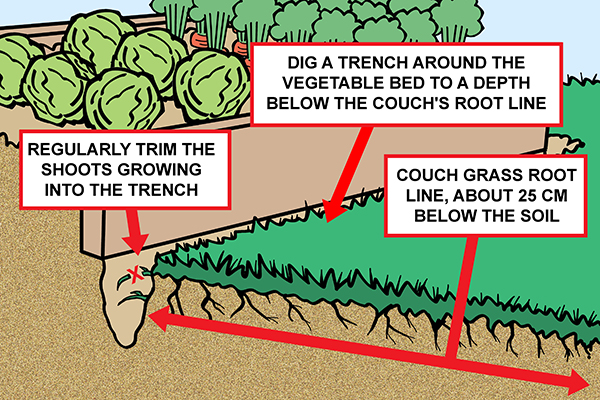
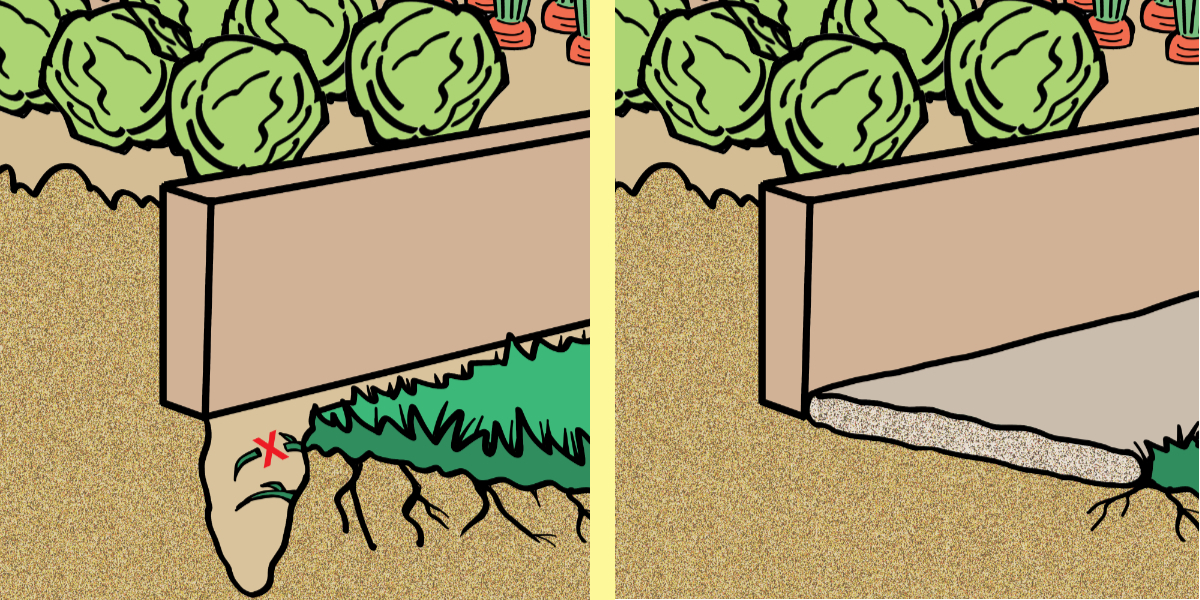
Couch grass is a shallow rooted plant that spreads by extending shoots under the ground horizontally. If you dig a trench to below the couch’s root line (about 25 to 30 cm deep) along the edge of your vegetable bed it will act as a barrier between your bed and the couch grass. The couch shoots do not grow down and below the trench but try to bridge it horizontally.
By regularly removing any soil building up in the trench (to maintain the depth of the trench to below the couch’s root line) and trimming the couch shoots trying to cross the trench it is possible to permanently keep the couch out of your beds.
Illustration of how to create a trench barrier to keep out couch grass.
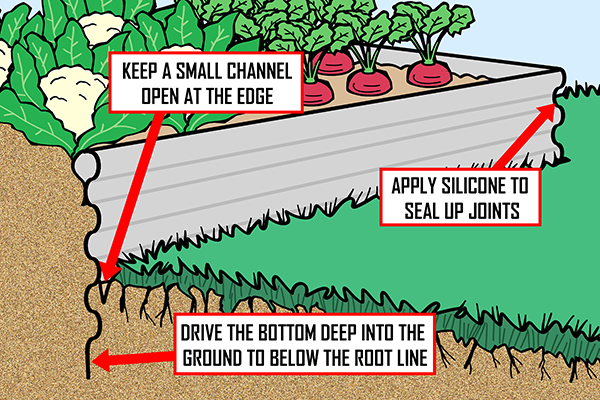
It is best to use premade galvanised or Colorbond raised beds, preferably ones that are 90 cm high, though 60 cm high raised beds can also be used. You can also use sheets of galvanised roofing iron, but it is hard to create an effective seal at the corners when using these sheets. To create a couch grass deep barrier follow these instructions.
MAKE SURE THAT WHERE YOU WANT TO PLACE THE RAISED BED HAS NO COUCH GRASS IN IT
- ASSEMBLE THE RAISED BED AND PLACE IT IN POSITION
- USE SILICONE TO SEAL ANY OF THE JOINTS IN THE RAISED BED
Couch shoots can get through very small gaps, so every possible gap needs to be sealed up. Let the silicon cure overnight so that it fully hardens. USE THE BLADE OF A SPADE TO PUSH DOWN INTO THE SOIL AT THE BOTTOM EDGE OF THE RAISED BED
This is to loosen up the soil.DRIVE THE RAISED BED INTO THE GROUND TO A DEPTH OF AROUND 25 TO 30 CM
If the soil is soft enough this can usually be achieved by pushing it in or tapping it with a soft mallet. If the ground is too hard to do this then push the raised bed in lightly to create an imprint in the soil, then temporarily remove it and dig a trench to the right depth using the imprint as a guideline. Reinsert the raised bed and backfill the trench.CUT A SMALL CHANNEL WHERE IT GROWS UP AGAINST THE RAISED BED
When couch runners strike a hard barrier such as the side of a raised bed it tends to grow upward towards the light. If the bottom of the raised bed is below the couch root line then no couch runners should be able to grow underneath it.MONITOR THE BED’S SOIL FOR ANY SIGNS THAT COUCH HAS BREACHED THE RAISED BED BARRIER
Using galvanised raised beds to create deep barriers is also an effective way to prevent raspberry bushes from spreading outwards when planted in the bed. Like couch grass, raspberry bushes spread by sending shallow runners out from the parent plant.
Illustration of how to create a deep barrier to keep out couch grass.
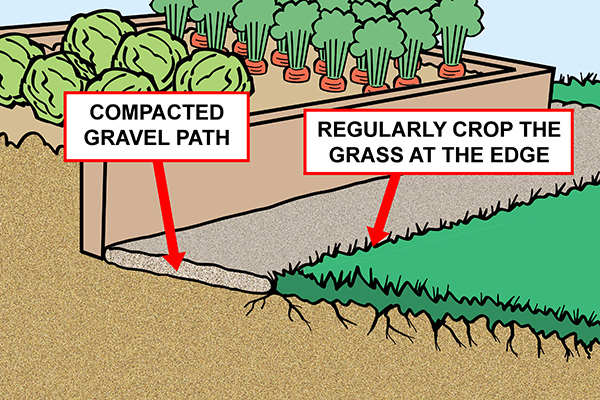
An excellent way to stop couch grass growing into a vegetable bed is to create a compacted gravel path around it. This is my preferred method for keeping couch out as (to date) it has been 100% effective and involves little follow up maintenance.
Couch likes to grow in soft soil, the softer the soil the quicker it will grow. When faced with hard ground such as a compacted gravel path it usually seeks softer ground to expand into. To create a couch grass path barrier follow these instructions.
DIG OUT THE SOIL AROUND YOUR BED TO A DEPTH OF AROUND 5 TO 10 CENTIMETRES AND AROUND ONE METRE WIDE
If the area is covered with lawn, then use a spade to peel the grass off in layered sections of about 5 cm deep (deeper if you think there are couch grass roots below that depth). Discard the lawn that you have peeled up.FILL THE PATH WITH HARD COMPACTING GRAVEL AND LEVEL IT
Here in Ballarat I use granite sand as it packs down to a very hard surface. Alternatives such as crushed bluestone rock or Tuscan toppings can also be used.
Illustration of a compacted gravel path couch barrier.
GRASS BARRIER
Couch grass usually finds it hard to grow into and established lawn of another grass species. By digging up the couch grass next to your vegetable bed to a width of around one and a half metres and sowing the bare soil with another hardy grass species then couch will find it difficult to grow through it to your bed once the other grass has established itself.
WICKING BED BARRIER
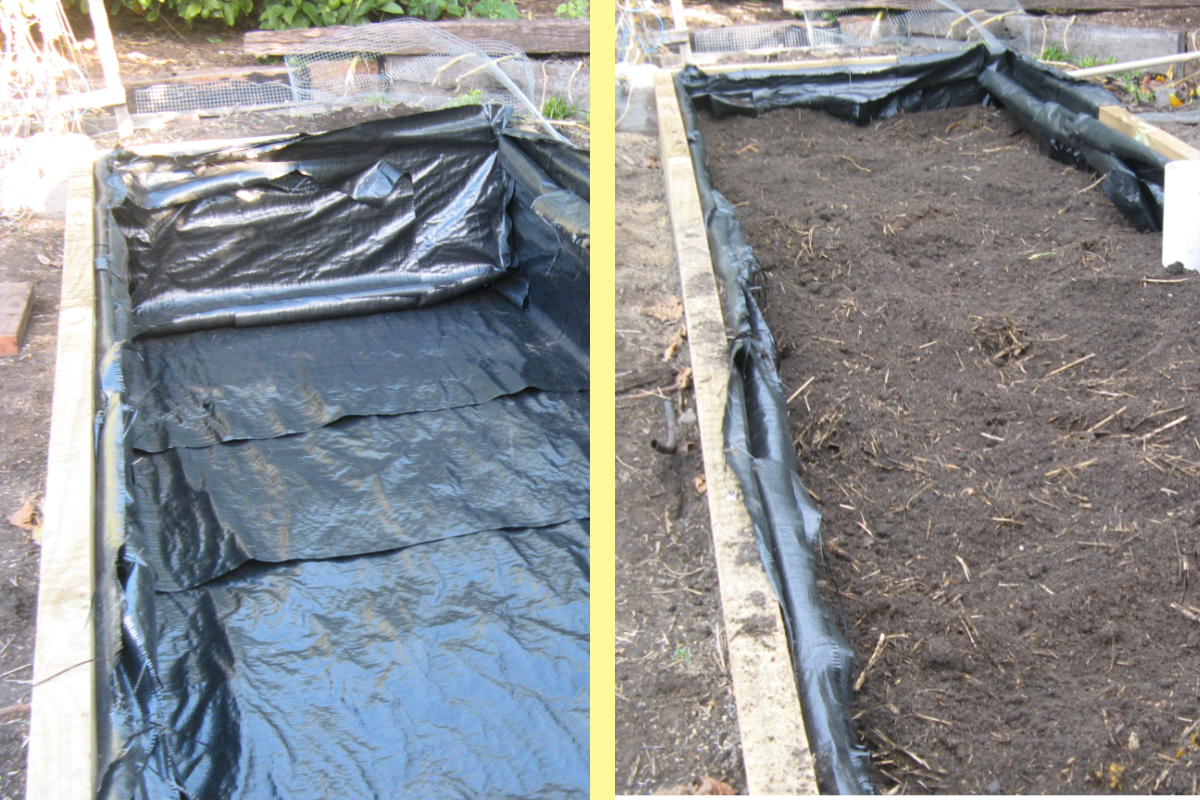
Wicking beds (beds with water reservoirs at their base) are completely sealed from the surrounding soil, which makes them a sound barrier against couch grass. They are also good at keeping tree roots out.
These photos were taken of a wicking bed that I constructed some years ago. LEFT: The base of the bed was covered with a vinal pond liner then overlayed with builders plastic on top of the pond liner and up the sides of the bed. This combination of pond liner and builders plastic makes it very difficult for couch grass to get into the bed. RIGHT: The same bed after it had been filled with soil. For detailed instructions on how I built this bed see: Building A Wooden Wicking Bed.