Arguably the most common reason for people giving up growing vegetables is out of control weeds. But an efficiently managed vegetable patch requires much less weeding time than you might think. Here are some tips on how to keep weeds in your vegetable patch under control with a minimum of effort.
When it comes to weeds in a vegetable bed couch grass is arguably most damaging of all the weeds. The one positive of couch is that it does not produce seeds, so if you can completely remove it from your vegetable beds it is relatively easy to keep out. Removing couch grass is not easy, especially if it is well entrenched, but unless you remove it completely it will always be a major thorn in your vegetable growing efforts. That is why it is so important to remove it completely as it will drastically reduce the amount of time you have to spend weeding.
To effectively remove Couch from your vegetable patch see Removing Couch Grass and to keep it out see Keeping Couch Grass Out Of Vegetable Beds.
It is important to regularly weed your vegetable beds to ensure that weeds to not grow too large. Large weeds:
COMPETE WITH VEGETABLE PLANTS FOR NUTRIENTS AND SUNLIGHT
MAY BECOME MATURE ENOUGH TO FLOWER AND SEED YOUR GARDEN WITH MORE WEEDS
HAVE THE POTENTIAL TO DAMAGE THE ROOTS OF NEARBY VEGETABLES WHEN PULLED OUT
Scheduling ten to fifteen minutes of time each week for weeding is normally enough time to keep even the biggest backyard vegetable patch largely weed free. A regularly scheduled weeding session is also a good time to check your vegetables for signs of disease and pests.
If weeds are left to grow too large they have the potential to damage nearby vegetable roots when the weeds are pulled out.
Scuff hoeing is when you break the soil just below the surface to disturb the roots of small weeds without removing the weeds by hand. Because you are only disturbing the surface soil it does little damage to larger vegetables as most of their roots will run deeper.
It works best as a way to remove small weeds in bare or lightly mulched soil. It is less suitable for removing large weeds or weeds in a heavily mulched bed.
The principle behind it is that small weeds cannot go without water, nutrients, or sunlight for any length of time. Scuff hoeing severs the roots of small weeds and often buries the weeds as well, thereby killing them.
To scuff hoe you need a single pronged or thin hoe. Suitable hoes include the Collinear Hoe, Wonder Weeder, Gung Hoe and Stirrup Hoe.
TOP: Collinear Hoe (also known as a Gung Hoe). BOTTOM: An old single pronged Trojan hoe I bought second hand many years ago, the modern day equivalent is the Cyclone Wonder Weeder.
Scuff hoeing demonstration using my single pronged hoe.
While Scuff Hoeing is an effective way to remove small weeds there is a risk of damaging vegetable plants when trying to remove small weeds that have sprouted right next to vegetables. The best way to remove these weeds is by hand scuffing. The human hand is far more dexterous than any garden tool; by agitating your fingers as your hand moves around the base of vegetable plants it is possible to remove small weeds without doing any damage to the roots of the vegetables.
Hand scuff hoeing demonstration.
Another way to limit the amount of weeding needed to keep your vegetable beds in good order is to cover them with mulch. Not only does mulch suppress weeds by burying weed seeds under its smothering layer but it also reduces evaporation in summer (less watering required) and provides vital organic matter for your garden’s soil.
But note that applying mulch can have negative consequences. Mulch acts as an insulating material, soil under mulch will be cooler than bare soil. In summer cooler soil is an advantage but in early/mid spring you want the soil to be as warm as possible to germinate seeds and promote the growth of seedlings. Mulch also offers ideal cover for small slugs, giving them easy access to any seedlings planted in a mulched bed.
For this reason I practice what I call Seasonal And Stages Mulching. This involves applying no mulch in winter through to mid-spring. The only exception being beds that are being fallowed, if a bed is being fallowed I cover it with mulch regardless of the time of year. For more information see: Seasonal And Stages Mulching Of Vegetable Beds.
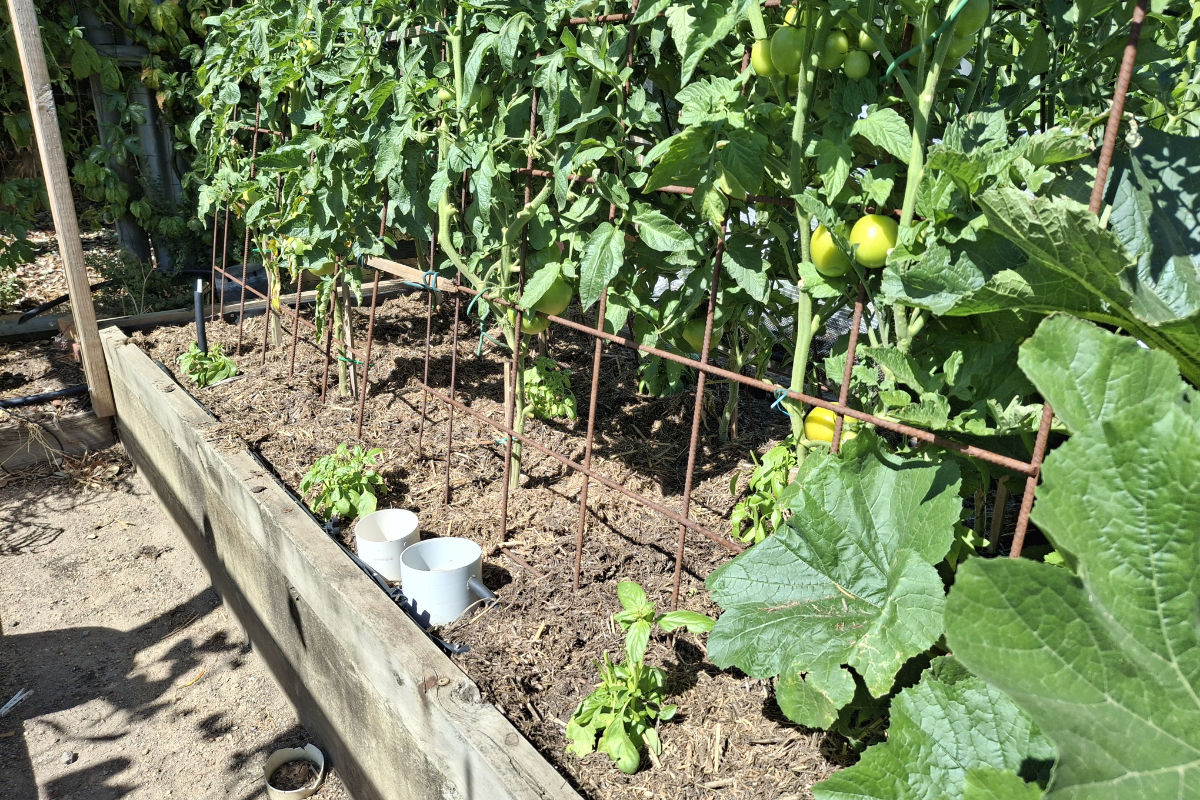
An example of using mulch to suppress weeds.
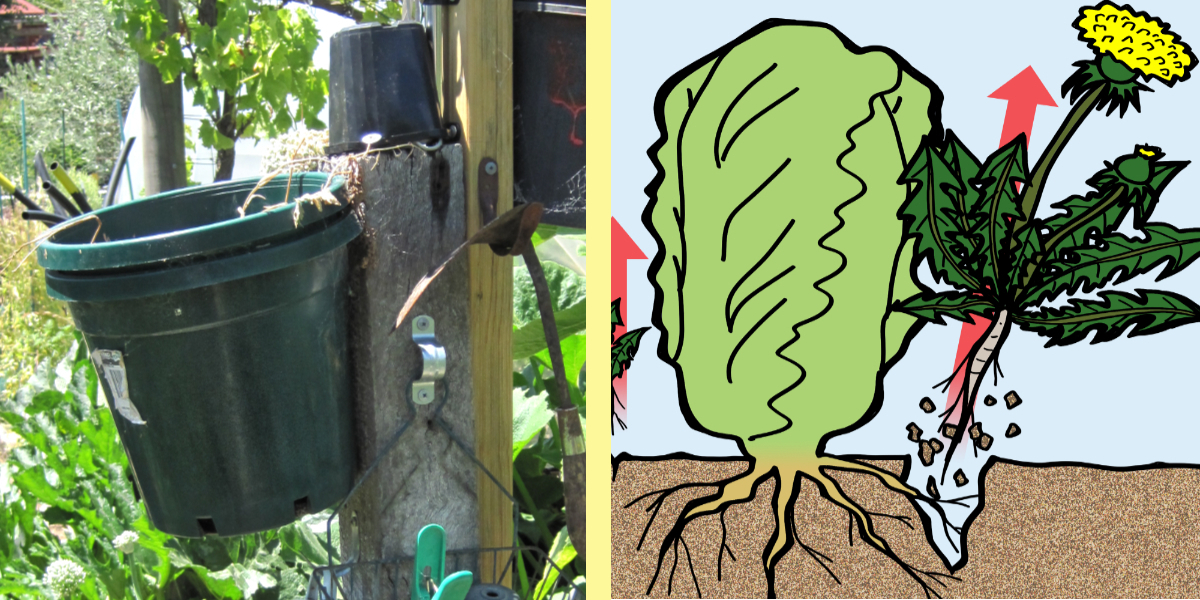
A spot weeding pot is a pot that sits in another pot of the same size which is secured to a post or fence. It is there to deposit any unexpected weeds that you find as you go about tending the garden. When the pot is full of weeds you simply empty it into your compost bin and return it to its bottom pot cradle. I have a number of these spot weeding pots strategically placed around the garden. Spot weeding pot stations reduce the amount of time spent transporting weeds to your compost bin.
Spot weeding pot in the centre of my main vegetable patch (left pot). When it is full of weeds I empty it in the compost bin and return the pot to its station. The smaller pot on the right is for things that cannot be composted, such as sticks, stones, and bits of plastic. When it is full it is emptied into the rubbish bin.
Spot weeding pot station demonstration.