While many gardeners visiting the Urban Food Garden website are on properties in the country the site is primarily aimed at those living in the urban environment and therefore have access to mains water. So in theory these gardeners have no need to install rainwater tanks as they have a ready supply of mains water on hand to water their garden. However there are good reasons to have rainwater tanks even when there is access to mains water. This post explains the reasons why.
Past droughts in south eastern Australia
In the last 130 years there have been five major droughts in South Eastern Australia.
Federation Drought (1895–1902)
WWII Drought (1937–1945)
The “Great Dry” (1982–1983)
Millennium Drought (1997–2009)
Tinderbox Drought (2017–2019)
All of which have caused incalculable damage to the environment and severe stock and crop losses for farmers. And when drought conditions exist water restrictions are invariably imposed on the use of mains water to water suburban gardens.
Factors affecting the likelihood of future water restrictions
There are three factors affecting the likelihood of water restrictions in the future. They are:-
1. Increased demand for water
Since the millennial drought (1997–2009) there has been a significant population increase in South Eastern Australia which has resulted in a rise in demand for mains supplied water.
2. A finite water storage capacity.
While demand for mains water has increased the storage capacity of our dams have remained the same. That is because all the available significant rivers in South Eastern Australia that can be dammed already have a dam on them. And even if the height of some dams were raised the catchment areas feeding water to those dams would remain the same.
Since the Millennial drought a number of water supply pipes (labelled as superpipes) have been built connecting various dams in different catchment areas. While these pipelines offer greater flexibility in water supply they do not increase the overall availability of water.
A desalination plant has also been built at Wonthaggi with a capacity to supply up to 200 billion litres per year. Desalination plants are a useful adjunct to dam water; however they are 40 times more energy intensive than sourcing water from dams.
3. The threat to water supplies caused by global warming
The overwhelming majority of climates scientists and governments around the world agree that anthropogenic driven global warming is occurring. Though it is difficult to accurately predict what will happen in the future Bureau Of Meteorology climate scientists are predicting that South Eastern Australia will progressively get warmer and dryer and already weather statistics indicate that this is occurring.
The increased likelihood of future water restrictions
When combined the above three factors point to an increased likelihood of more numerous, longer lasting and more severe water restrictions in the future.
The difficulty of watering vegetables with only mains water when water restrictions are in place
Water restrictions can vary depending on the length and severity of a drought and to what extend dams and water catchments supplying the different areas can build up a water reserve when rain does fall. During the Millennium Drought (the last drought to severely impact Ballarat’s water supply) gardeners were allowed to water their gardens for one hour every second day.
This was adequate for watering established perennials but in warmer weather vegetables, especially water hungry vegetables and seedlings, require daily watering and in some cases may need to be watered twice daily.
The role of rainwater tanks in an urban garden
The main aim of having a rainwater tank in a mains water supplied garden is not to provide all the garden’s watering needs (though this is desirable) but to offer watering flexibility. While mains water use is restricted during a drought there are no water restrictions on the use of rainwater collected from your house’s roof and stored in a water tank. This allows gardeners to use their rainwater to water vegetables that need more frequent watering outside the hours allocated for watering gardens when water restrictions are in place.
If water restrictions are severe enough they will reduce the gardener’s capacity to grow vegetables and supply water to fruit trees but having at least one rainwater tank will diminish the likelihood of this occurring.
Rainwater tank options
Large rainwater tanks (5,000 Lt plus)
It is desirable to install the biggest rainwater tank that the gardener can afford, have the space for and with a big enough roof runoff to fill the tank even when rainfall is below average. When absolutely no rain falls large rainwater tanks allow gardeners to water their garden for longer than smaller tanks before running dry.
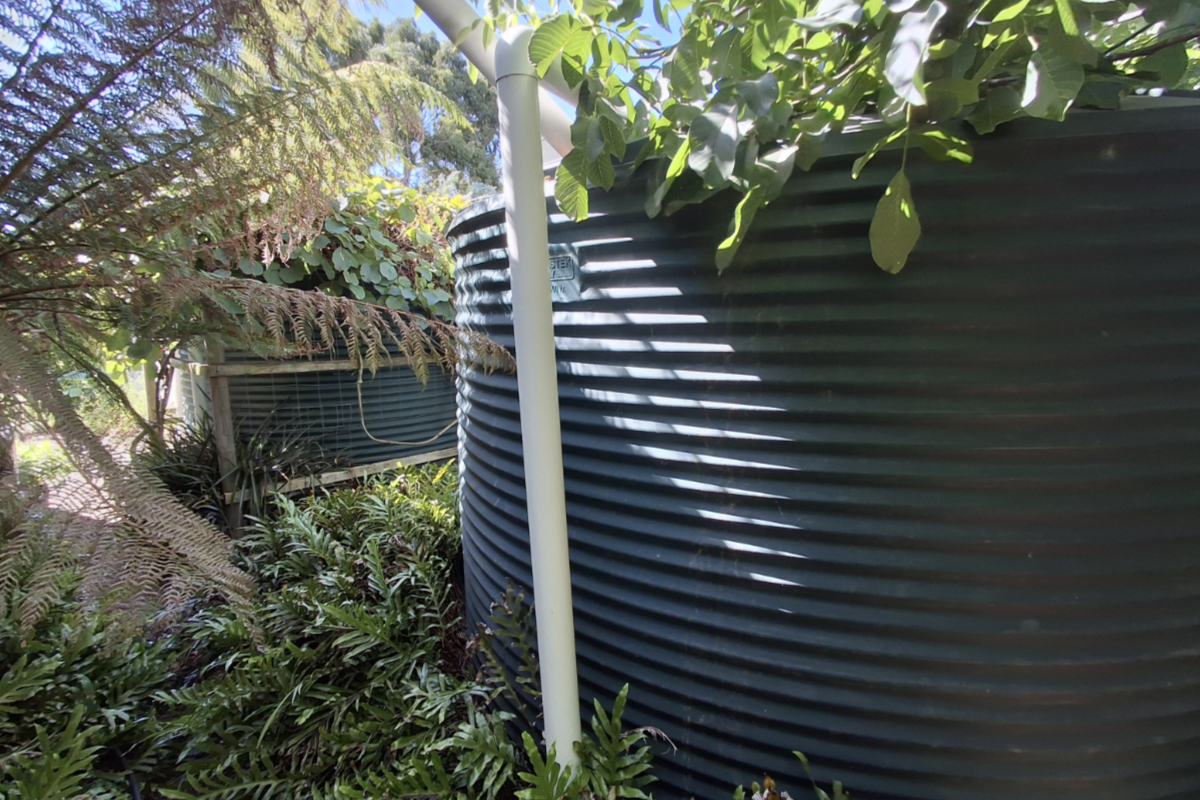
Our two 13,500 litre rainwater tanks. In summer they cannot supply all our garden watering needs but they greatly reduce our reliance on mains water. When demand for water is not so great in spring and autumn they usually can supply 100% of our garden’s water needs. These tanks were the biggest we could afford at the time. The tank in the foreground was bought first followed by the second some years later.
Small to medium rainwater tanks
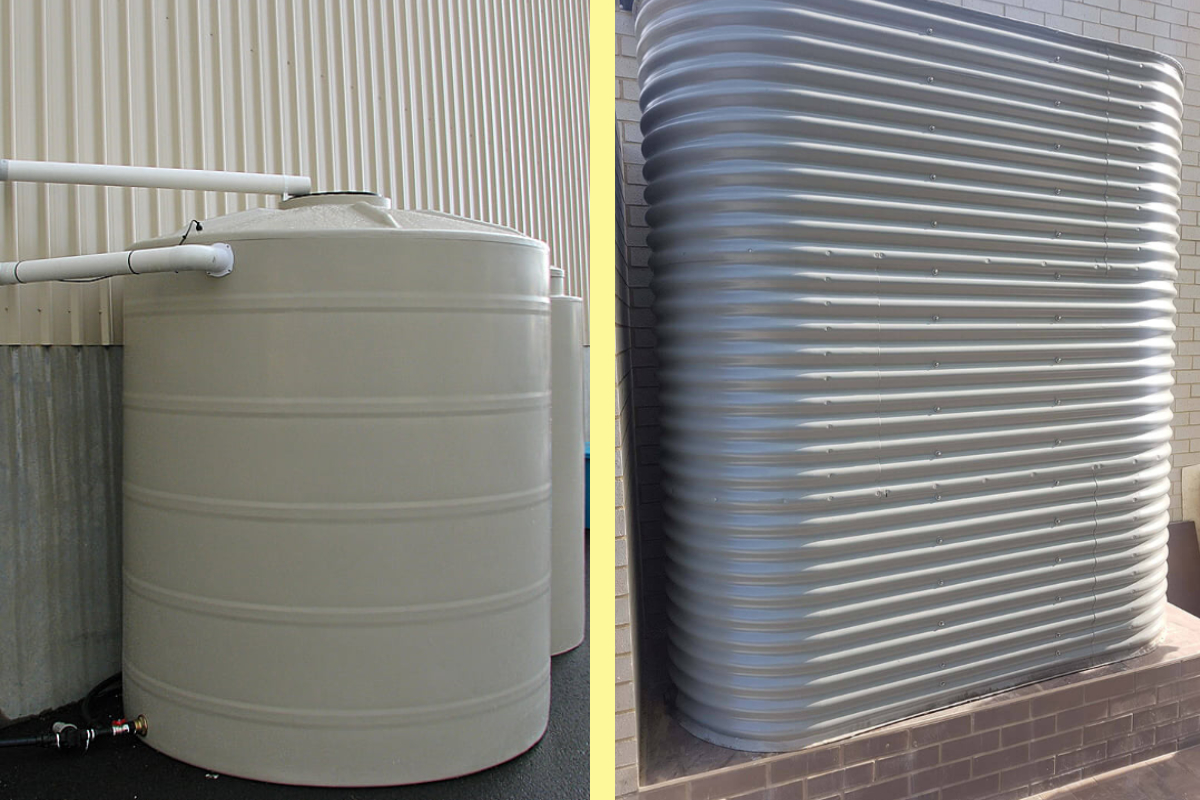
Small to medium rainwater tanks (up to 5,000 Lt) are more affordable than large tanks and useful in gardens where space is a premium. They also come in varying shapes making them suitable for tight corners. Such tanks are ideal for small and medium sized gardens.
Two examples of small water tanks. Images courtesy of the internet.
Budget and temporary alternatives.
For people living in rental properties or on a very tight budget purpose build rainwater tanks of any size are not an option, but this does not mean they can’t have a rainwater storage tank. Second hand Intermediate Bulk Containers (IBCs) can be bought for less than $100 (2026 prices) and old 44 gallon drums for even less. They can be installed by simply diverting a section of downpipe so that rainwater runoff flows into the container. If renting they can be easily installed and removed when tenants eventually move on.
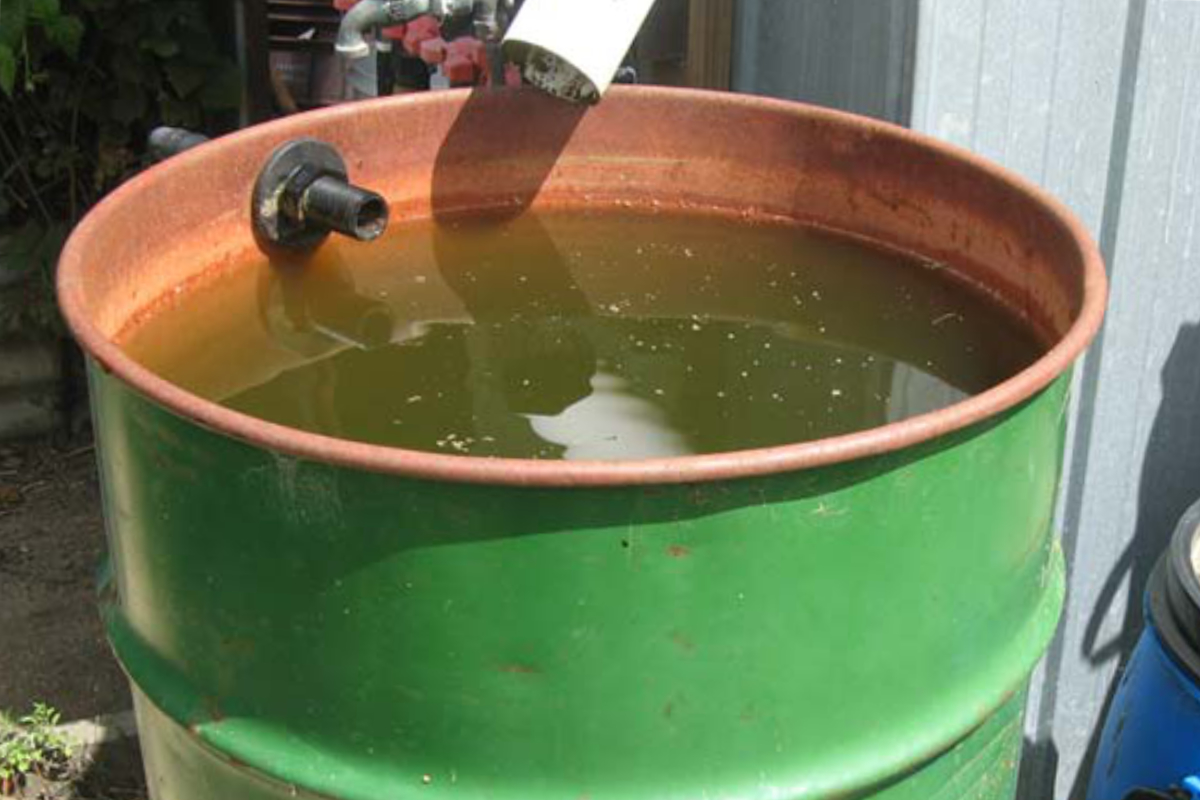
Our first rainwater storage container was this 44 gallon drum which we had prior to buying our existing rainwater tanks. This drum did not supply water by hose but is what is called a dipping drum, which is an open toped drum that allows the gardener to dip a watering can into it to draw water. It’s capacity to draw water is limited but it is still very useful as an adjunct to watering the garden using mains water.
This video of me filling my watering can from my dipping drum shows how effective they are. Even though we now have two large rainwater tanks I still regularly use my dipping drum for watering with diluted liquid fertiliser. The original 44 gallon drum (photo above this video) has long since rusted out and was replaced with this polyethylene drum.
rainwater tank dispensing options
Using gravity
Gravity fed tank water is when water is extracted from the base of a water tank using gravity alone. Initially I used gravity to supply water from our 13,500 Lt water tank but I soon realised using gravity to supply water has two significand shortcomings.
THE FLOW RATE WAS WAY TOO LOW It was taking hours to water a section of the garden which would have taken minutes.
THE PRESSURE TOO LOW TO USE WATERING TIMERS Tap timers and solenoid valves used in automatic irrigation systems need mains pressure to work properly. The timer I used would start on time but then would not shut off when the allocated time had been completed.
Supplying water using gravity feed from a rainwater tank is possible on a very steep block but on our gently sloping block it was not feasible.
With a pressure pump
An electric pressure pump allows a gardener to water a garden with the equivalent of mains pressure. When I installed our pressure pump it made watering the garden much easier and allowed me to use tap timers and irrigation system solenoid valves to water the garden automatically.
These days you can buy cheap pressure pumps for less than $200, making it feasible to use a pressure pump on even small rainwater tanks.
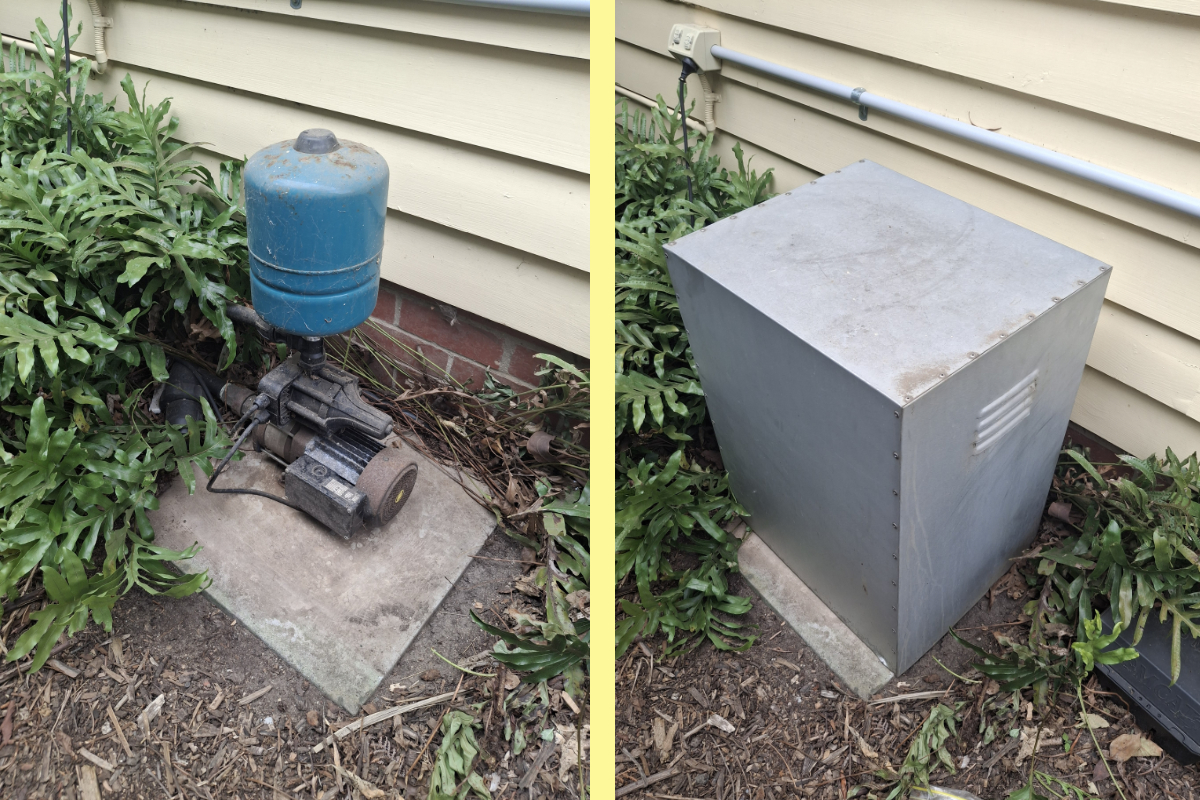
LEFT: The Grundfos pump that I connected to our two 13,500 Lt tanks. It was relatively expensive but it is now over twenty years old and still going strong. RIGHT: The cover used to protect the pump from the elements.
Running a small tank as a dipping drum
Using a dipping drum (as mentioned above) is an efficient way to water a small vegetable patch. It is an especially useful way to water seedlings.
Water supply flexibility
As most of the time I am watering with a combination of mains and rainwater tank water I found it useful to have a watering system that allows me to easily switch between the two.
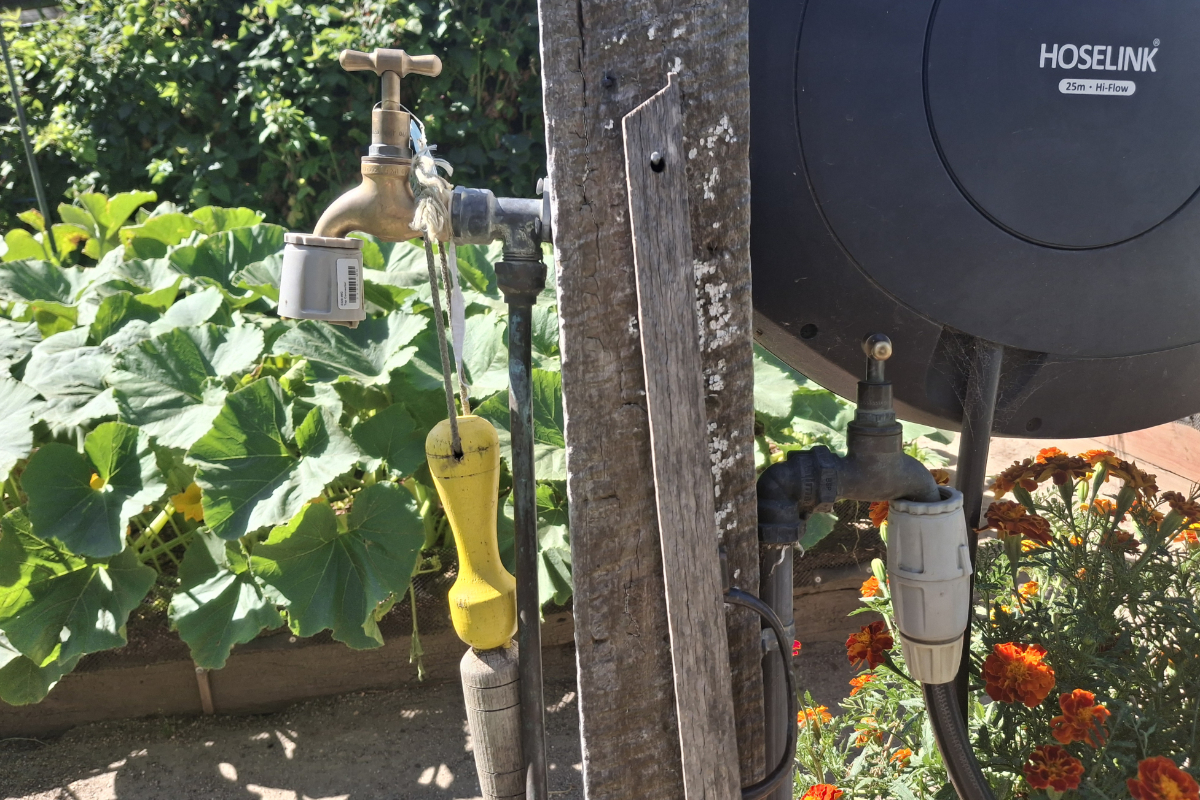
LEFT: The mains water tap in the vegetable garden. RIGHT: The rainwater tank tap that is right next to it. Having them close together means that I can easily switch my garden hose from mains to rainwater and vice versa at a moment’s notice.
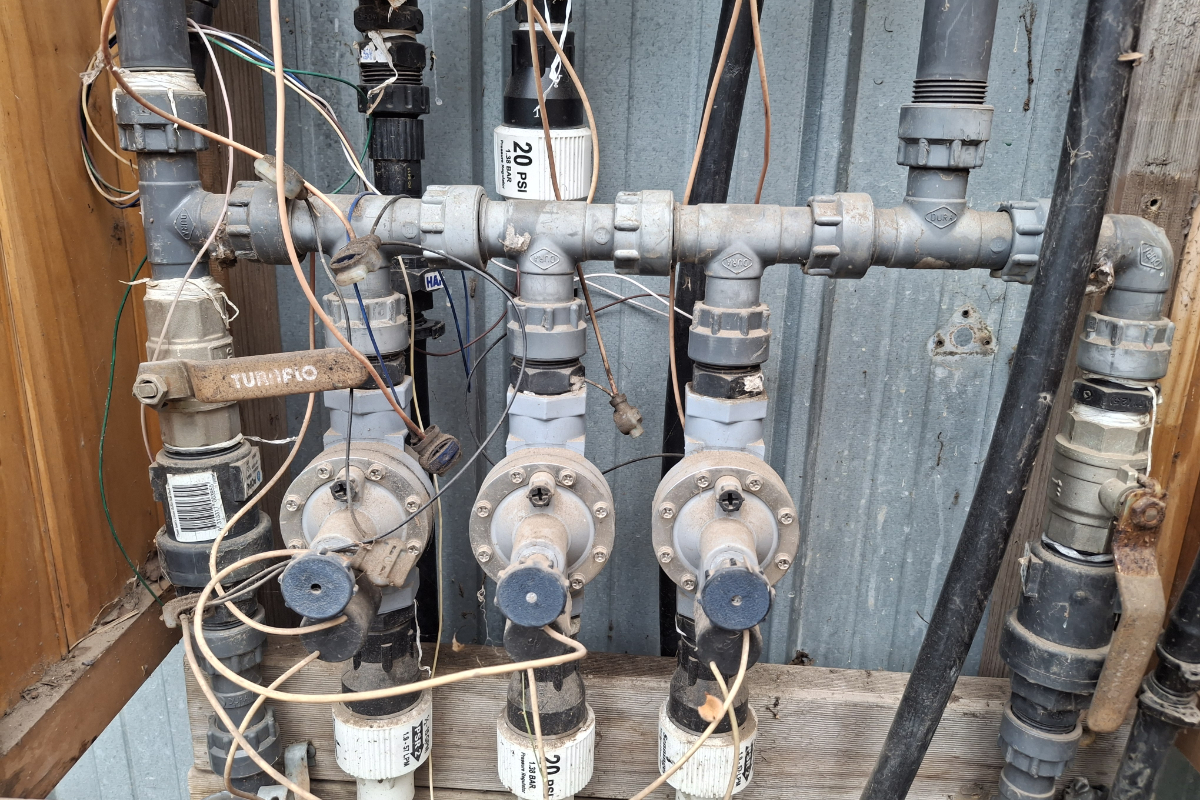
I use an irrigation controller to do most of my automatic watering. By opening and shutting just four valves I can easily switch the water supply to the controller’s solenoid valves from mains to rainwater and vice versa.